
New Products
-
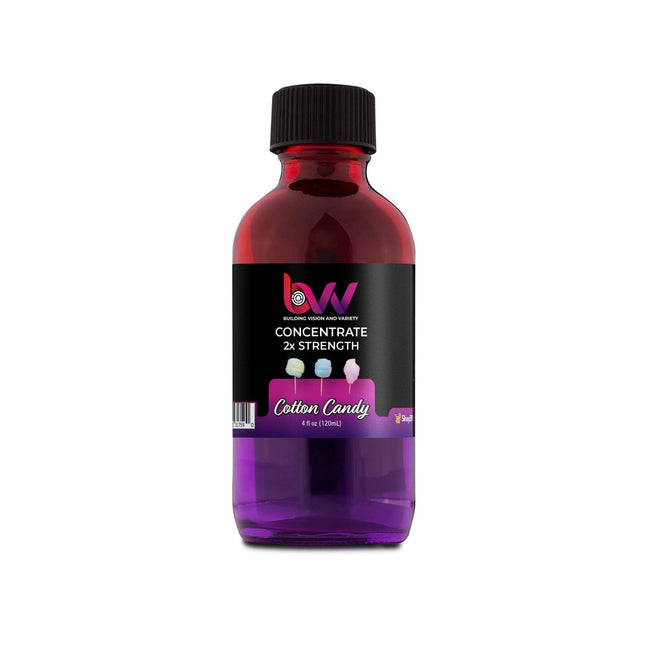

Cotton Candy
BVV™ Cotton Candy All sales are final. Orders can be refunded prior to fulfillment and shipping but once the order has been fulfilled and/or shipped, no refunds will be issued. Due to the hazardous nature of our product, we are unable to accept returns. BVV™ Concentrates are botanically derived terpenes enhanced with "nature-identical" artificial flavors. These flavors boost the natural flavor profile of the concentrate, providing the user with a more pleasant vaping experience. In order to provide complete transparency and elicit customer confidence, all ingredients are disclosed in the technical datasheet. BVV™ Cotton Candy Safety Data Sheet Cotton Candy is truly a delight for the senses. It has a bright, sweet, sugary flavor that taste exactly like cotton candy. It has been known to make a person, calm, happy, and giggly. The Cotton Candy strain can also assist with alleviating anxiety and depression. FRAGRANCE: Sweet, fruity, and berry. EFFECT: Uplifting, euphoric, energetic accompanied by a soothing sensation. Storage Requirements: Keep in the original container, lid securely tightened and away from heat, open flames, sunlight, combustible materials, and hot surfaces. Store below 15℃ (60℉). Improper storage can cause terpenes to degrade. Dilution: Concentrates must be diluted prior to use for flavor and effect (1-3% by total volume). Concentrates are oil soluble and mix well with plant extracts, coconut oil, and more. Handle With Care: Can cause skin irritation, do not ingest PRIOR to dilution.
$11.00 - $165.00
-
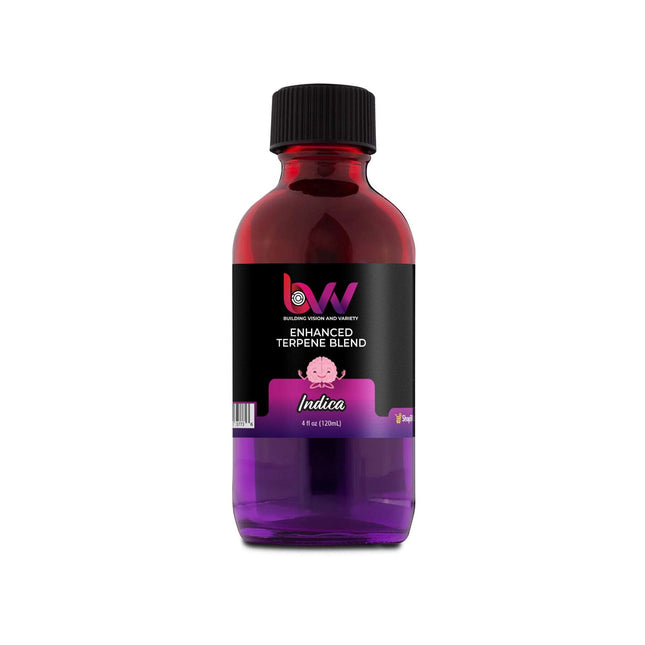

Terpenes Indica
BVV™ Terpenes Indica All sales are final. Orders can be refunded prior to fulfillment and shipping but once the order has been fulfilled and/or shipped, no refunds will be issued. Due to the hazardous nature of our product, we are unable to accept returns. BVV™ Terpenes are botanically derived terpenes enhanced with "nature-identical" artificial flavors. These flavors boost the natural flavor profile of the terpenes, providing the user with a more pleasant vaping experience. In order to provide complete transparency and elicit customer confidence, all ingredients are disclosed in the technical datasheet. BVV™ Indica Safety Data Sheet Indica is known for its relaxing and therapeutic qualities in the body. Indica's are something people often turn to when suffering from pain or they lack the ability to fall asleep. FRAGRANCE: Earthy and Skunky. EFFECT: Relaxing body high that can reduce pain, assist with sleep, and increase appetite. Storage Requirements: Keep in the original container, lid securely tightened and away from heat, open flames, sunlight, combustible materials, and hot surfaces. Store below 15℃ (60℉). Improper storage can cause terpenes to degrade. Dilution: Terpenes must be diluted prior to use for flavor and effect (1-5% by total volume). Terpenes are oil soluble and mix well with plant extracts, coconut oil, and more. Handle With Care: Can cause skin irritation, do not ingest PRIOR to dilution.
$11.00 - $165.00
-
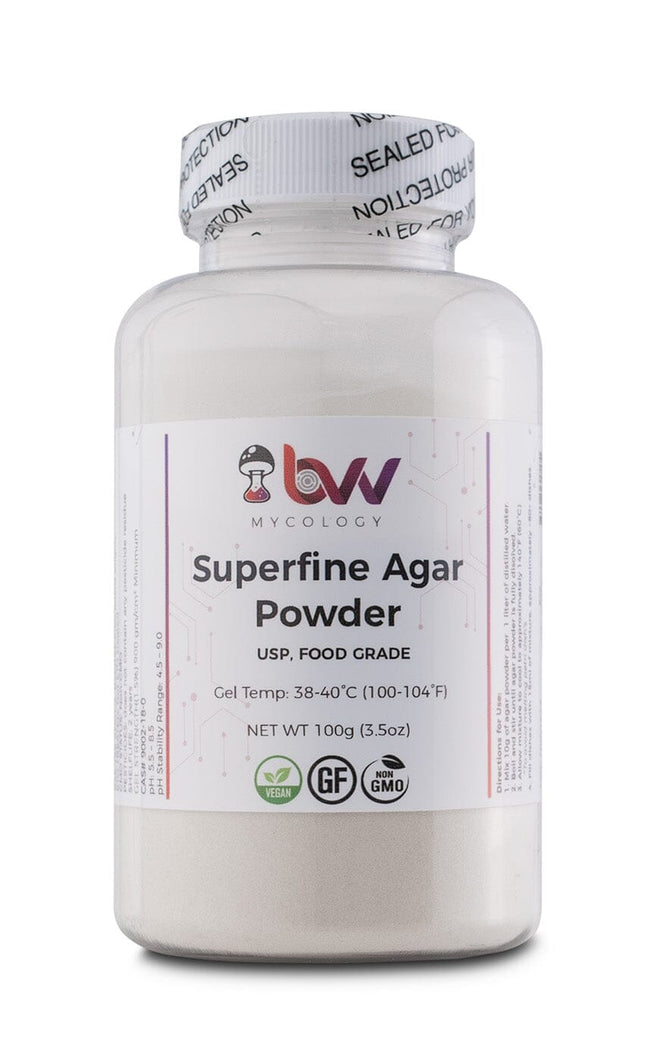

Superfine Agar Powder for Mushrooms Mycology Petri Dishes
Superfine Agar Powder Bacteriological, Food Grade, USP-NF Our Agar Powder is extracted from Red Seaweed. Our agar is a complex polysaccharide and is a top choice for mycology cultures. This superfine agar dissolves quickly and has a high gel strength making it an excellent choice for a variety of applications an petri dishes. Gel Strength (1.5%) : 1020 gm/cm² Gel Temperature: 38-40°C (100-104°F) CAS# 9002-18-0 Gluten Free Allergen Free Vegan & Vegetarian approved Non-GMO Shelf Life: 2 years pH: 5.5-8.5 Superfine Agar Powder Certificate of Analysis Directions for Use: Mix 10g of superfine agar powder per 500ml of distilled water. Boil and stir until powder is fully dissolved. Sterilize the mixture for 45min @15psi 250°F (121°C) in a pressure cooker or autoclave. Allow mixture to cool to approximately 140°F (60°C) *To avoid excessive condensation. Fill dishes with 15ml of mixture, approximately ~30-35 dishes.
$21.00 - $150.00
-
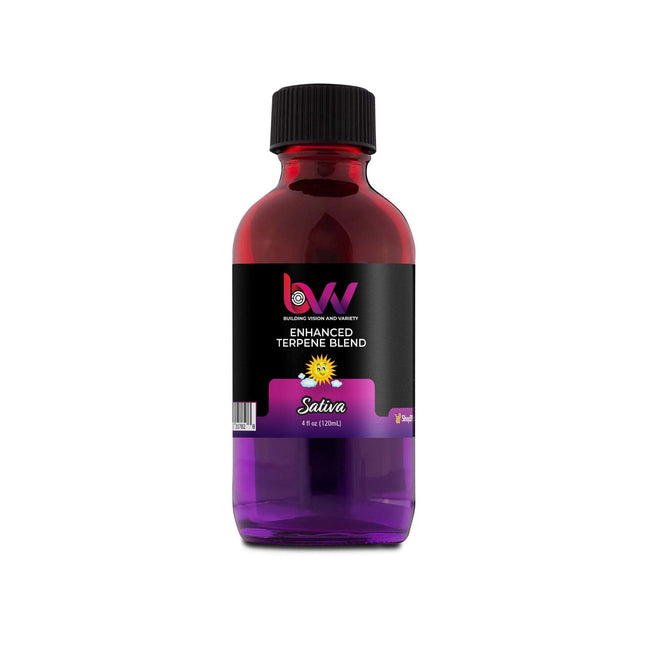

Terpenes Sativa
BVV™ Terpenes Sativa All sales are final. Orders can be refunded prior to fulfillment and shipping but once the order has been fulfilled and/or shipped, no refunds will be issued. Due to the hazardous nature of our product, we are unable to accept returns. BVV™ Terpenes are botanically derived terpenes enhanced with "nature-identical" artificial flavors. These flavors boost the natural flavor profile of the terpenes, providing the user with a more pleasant vaping experience. In order to provide complete transparency and elicit customer confidence, all ingredients are disclosed in the technical data sheet. BVV Sativa Safety Data Sheet SATIVA: This terpene is robust and has a distinct citrus, menthol flavor with a touch of sour. Sativa tends to be more stimulating and gives you an energy boost. It can uplift mood, and may reduce anxiety. Best for daytime to assist with creativity throughout your day. FRAGRANCE: Spicy and Sweet. EFFECT: Tends to be more stimulating. It can uplift mood, and may reduce anxiety. Best for daytime to assist with creativity throughout your day. Storage Requirements: Keep in the original container, lid securely tightened and away from heat, open flames, sunlight, combustible materials, and hot surfaces. Store below 15℃ (60℉). Improper storage can cause terpenes to degrade. Dilution: Terpenes must be diluted prior to use for flavor and effect (1-5% by total volume). Terpenes are oil soluble and mix well with plant extracts, coconut oil, and more. Handle With Care: Can cause skin irritation, do not ingest PRIOR to dilution.
$11.00 - $165.00
-
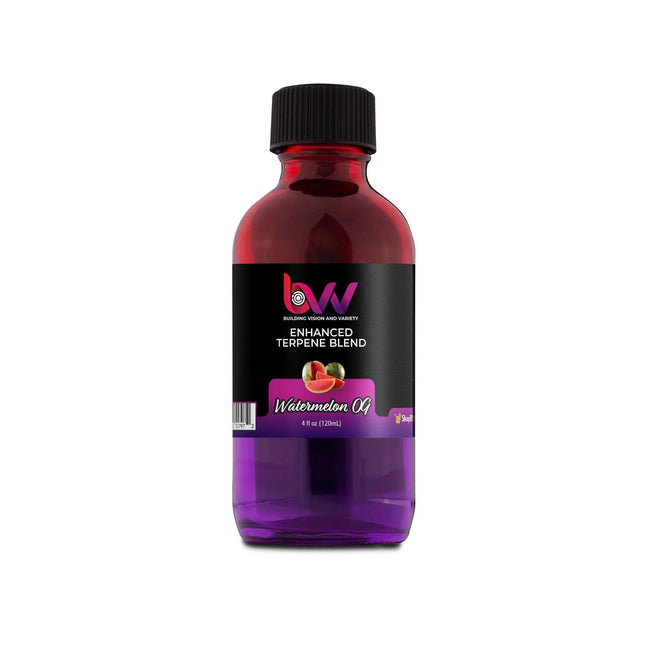

Terpenes Watermelon OG
BVV™ Terpenes Watermelon OG All sales are final. Orders can be refunded prior to fulfillment and shipping but once the order has been fulfilled and/or shipped, no refunds will be issued. Due to the hazardous nature of our product, we are unable to accept returns. BVV™ Terpenes are botanically derived terpenes enhanced with "nature-identical" artificial flavors. These flavors boost the natural flavor profile of the terpenes, providing the user with a more pleasant vaping experience. In order to provide complete transparency and elicit customer confidence, all ingredients are disclosed in the technical data sheet. BVV Watermelon OG Safety Data Sheet BVV Watermelon OG Technical Data Sheet Watermelon OG: This sweet and sour fruity tasting terpene is known to relax to help assist with better sleep and some say it even helps increase appetite. Not only does Watermelon OG enhances mood but it also provides the vibe of euphoria. FRAGRANCE: Tropical and Fruity. EFFECT: Mood Elevating, Promotes Relaxation, Increase Appetite. Storage Requirements: Keep in the original container, lid securely tightened and away from heat, open flames, sunlight, combustible materials, and hot surfaces. Store below 15℃ (60℉). Improper storage can cause terpenes to degrade. Dilution: Terpenes must be diluted prior to use for flavor and effect (1-5% by total volume). Terpenes are oil soluble and mix well with plant extracts, coconut oil, and more. Handle With Care: Can cause skin irritation, do not ingest PRIOR to dilution.
$11.00 - $165.00
-
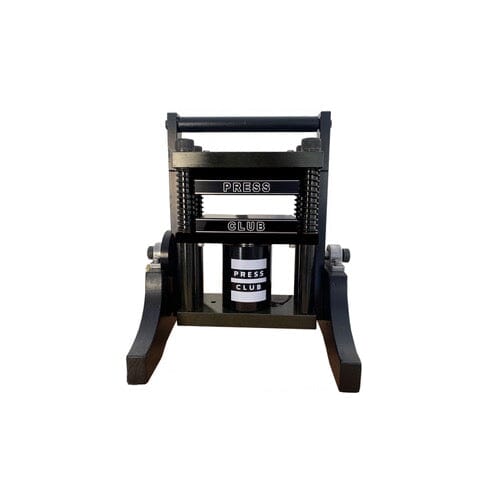
The Press Club The Press Club 3" x 5" Easy Drip Rosin Press
3" x 5" Easy Drip Rosin Press Available in two sizes (3” x 5” and 4” x 7”), each press is thoughtfully designed and handcrafted by top solventless experts in the industry. We even developed our own in-house hydraulic ram and pump. WHAT’S INCLUDED WITH EACH KIT - 3" x 5" Rosin Press Kit - 10 Ton Hydraulic Ram / Pump (Hard Case Included), Dual PID Controller, Integrated Easy Drip Tech Tilting Base, Stickers and more 4" x 7" Rosin Press Kit - 20 Ton Hydraulic Ram / Pump (Hard Case Included), Dual PID Controller, Integrated Easy Drip Tech Tilting Base, Stickers and more KEY FEATURES MADE FROM HIGH-QUALITY, INDUSTRIAL-GRADE MATERIALS (Certified American 6061 Aluminum & 304 Stainless Steel) UNDER 45LBS / PORTABLE / TOP HANDLE FOR EASY TRAVELING ULTRA COMPACT & STURDY (measures less than 12” in L x W x H) PATENTED EASY DRIP TECHNOLOGY (go from horizontal to tilted press in less than 3-secs) TOP OF THE LINE INSULATION TO PREVENT HEAT DISSIPATION FROM TOP / BOTTOM PLATES DUAL HEAT CONTROLLER W/ AUTOMATIC SAFETY SWITCH (easily control each top and bottom plate with our easy 2 button set and forget it operation) THE PRESS CLUB BRAND HYDRAULIC RAM / PUMP (HARD CASE INCLUDED) LIFETIME WARRANTY / 2-YEAR WARRANTY ON ELECTRICAL COMPONENTS HANDMADE IN NORTH AMERICA 1018 Cold Rolled Steel w/ Black Zinc Nickel Plating 6061 Aluminum Plates Press Plates
$3,500.00 - $4,500.00
-
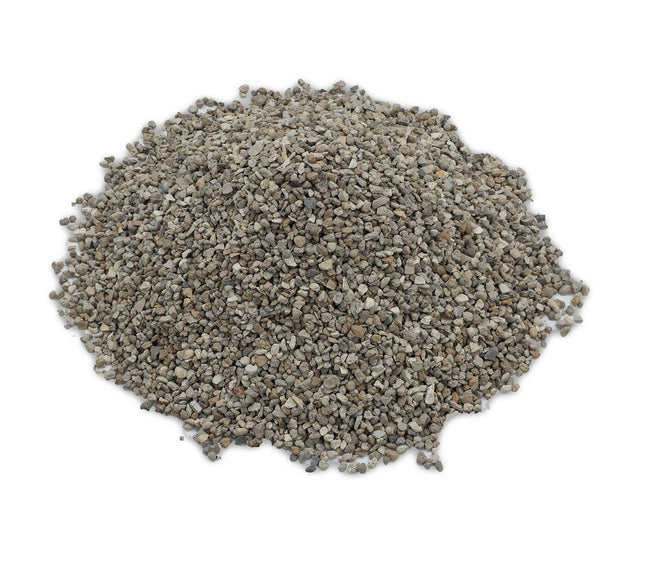

Ultra Clear L - Granular High Performance Bentonite for Bleaching & Decolorizing Edible Oils
Ultra:Clear® L 8/16 Mesh Made in USA, Food Grade Certified Ultra-Clear® L effectively removes color bodies, surfactants, water, free fatty acids, organic oxides, and other polar contaminants from a wide range of oils, liquids, and waxes. It is the Largest particle size in the Ultra-Clear product line. UltraClear® L is a unique, naturally occurring attapulgite that has been thermally processed to provide hard, durable granules that won’t swell or breakdown in the presence of water. All Ultra-Clear products are classified as processing aids andhave Generally Recognized As Safe (GRAS) status from theFood and Drug Administration (FDA). At BVV™ we recommend 200g per lb. of biomass. We also use this media with layering techniques & can be used with BVV™ Silica Gel and BVV™ Neutral Activated Alumina for a sugar in the oven finish! Ultra-Clear® is manufactured in 4 granule sizes, 8/16, 16/30, 30/60 & 60/90 mesh sizes. See the technical data sheet for more information from the manufacturer. Ultra:Clear® L Food Grade Certificate Ultra:Clear® L Technical Data Sheet Ultra:Clear® L Safety Data Sheet
$35.00 - $2,750.00
-


Ultra Clear M - Granular High Performance Bentonite for Bleaching & Decolorizing Edible Oils
Ultra:Clear® M 16/30 Mesh Made in USA, Food Grade Certified Ultra-Clear® M effectively removes color bodies, surfactants, water, free fatty acids, organic oxides, and other polar contaminants from a wide range of oils, liquids, and waxes. It is the Second Largest particle size in the Ultra-Clear product line. UltraClear® M is a unique, naturally occurring attapulgite that has been thermally processed to provide hard, durable granules that won’t swell or breakdown in the presence of water. All Ultra-Clear products are classified as processing aids andhave Generally Recognized As Safe (GRAS) status from theFood and Drug Administration (FDA). At BVV™ we recommend 150g per lb. of biomass. We also use this media with layering techniques & can be used with BVV™ Silica Gel and BVV™ Neutral Activated Alumina for a sugar in the oven finish! Ultra-Clear® is manufactured in 4 granule sizes, 8/16, 16/30, 30/60 & 60/90 mesh sizes. See the technical data sheet for more information from the manufacturer. Ultra:Clear® M Food Grade Certificate Ultra:Clear® M Technical Data Sheet Ultra:Clear® M Safety Data Sheet
$35.00 - $2,750.00
-
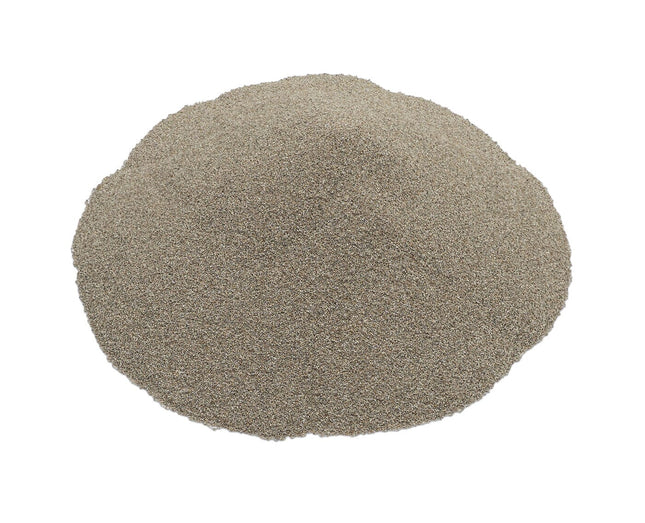

Ultra Clear S - Granular High Performance Bentonite for Bleaching & Decolorizing Edible Oils
Ultra:Clear® S 60/90 Mesh Made in USA, Food Grade Certified Ultra-Clear® S effectively removes color bodies, surfactants, water, free fatty acids, organic oxides, and other polar contaminants from a wide range of oils, liquids, and waxes. It is the Smallest particle size in the Ultra-Clear product line. UltraClear® S is a unique, naturally occurring attapulgite that has been thermally processed to provide hard, durable granules that won’t swell or breakdown in the presence of water. All Ultra-Clear products are classified as processing aids andhave Generally Recognized As Safe (GRAS) status from theFood and Drug Administration (FDA). At BVV™ we recommend 100g per lb. of biomass. We also use this media with layering techniques & can be used with BVV™ Silica Gel and BVV™ Neutral Activated Alumina for a sugar in the oven finish! Ultra-Clear® is manufactured in 4 granule sizes, 8/16, 16/30, 30/60 & 60/90 mesh sizes. Ultra-Clear® S is the smallest particle size and will offer the greatest surface area while remaining a High-Flow media for your extraction. See the technical data sheet for more information from the manufacturer. Ultra:Clear® S Food Grade Certificate Ultra:Clear® S Technical Data Sheet Ultra:Clear® S Safety Data Sheet
$35.00 - $2,750.00
-
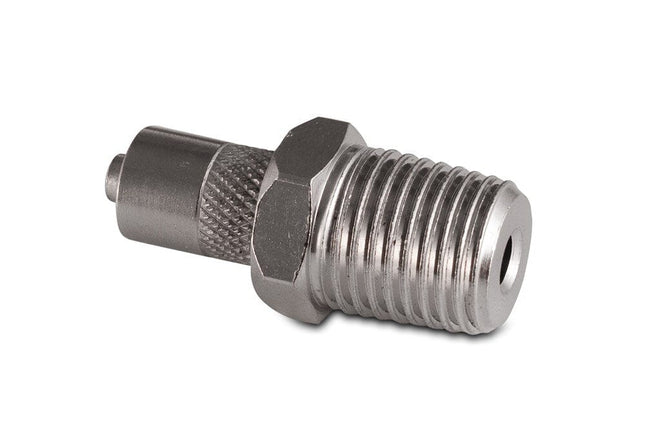

Male Luer to 1/4 NPT Male Nickle Plated Brass
Male Luer to 1/4 NPT Male, Fitting Material Brass- Nickle Plated.
$25.00
-
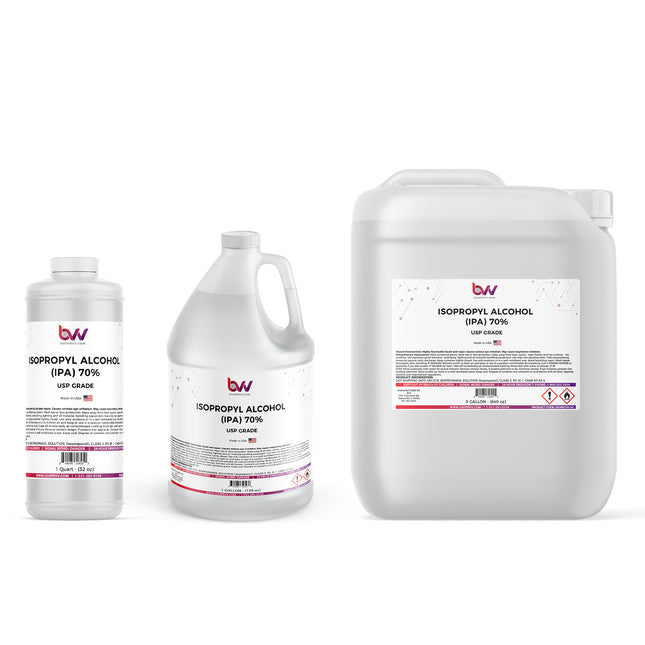

Isopropyl Alcohol 70% USP
Isopropyl Alcohol 70% USP Isopropyl alcohol is a fast-evaporating solvent and industrial cleaning agent, intended for industrial or professional use only. It can be used as a solvent for gums, shellac, and essential oils. Can be used as a fuel additive. Isopropyl Alcohol (liquid) - 70% Purity / 30% De-Ionized Water Shelf Life - 5 years *Disclaimer: 1 Quart Bottles are exempt from additional Hazmat shipping charges and can ship immediately, Less paperwork for shipping is required for shipping only 1 single bottle per order. Chemical Formula: C3H8O Molecular Weight: 60.096 g/mol CAS Registry Number: 67-63-0 Appearance Colorless Liquid Odor: Pungent Alcoholic odor Density 0.786 g/cm3 (20 °C) Boiling Point: 82.6 °C /180.7 °F Solubility in water: miscible GHS Pictograms: GHS Signal Word: Danger GHS Hazard Statements: H225, H302, H319, H336 GHS Precautionary Statements P210, P261, P305+P351+P338 UN Identification Number: 1219 Proper Shipping Name: Isopropanol Transport Hazard Class: 3 Packing Group: II DOT Placard: Isopropyl Alcohol 70% Safety Data Sheet (SDS) Isopropyl Alcohol 70% Certificate of Analysis (COA)
$20.00 - $3,000.00
-


Neocision Vacuum Oven Shelves
Neocision Vacuum Oven Shelves These are stainless steel oven shelves for our Neocision Vacuum Ovens and fit either a 0.9CF or a 1.9CF Neocision Oven. Specifications: 0.9CF - 11" (279mm) x 11.2" (285mm) x 1/8" Thickness 1.9CF - 14" (356mm) x 15.75" (400mm) x 1/8" Thickness
$35.00 - $45.00
-
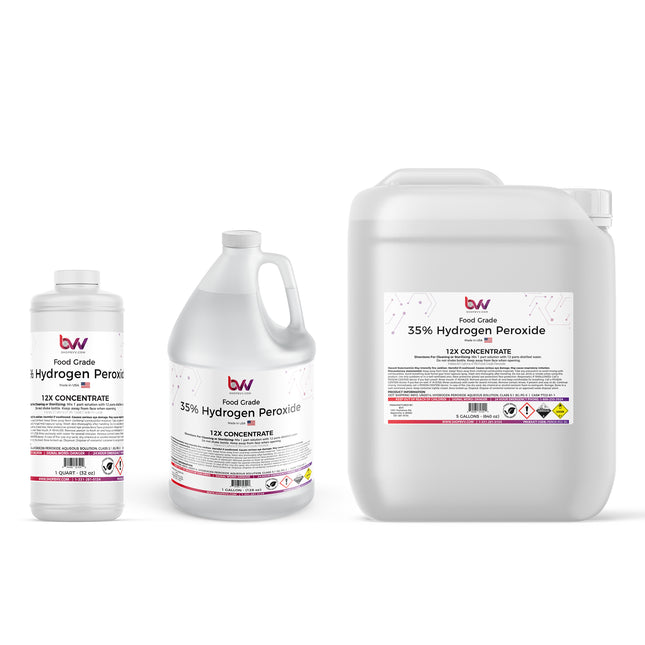
35% Hydrogen Peroxide Food Grade H2O2
35% Food Grade Hydrogen Peroxide This is the second highest concentration of hydrogen peroxide we offer just under our 50% Food Grade Hydrogen Peroxide. Our food-grade peroxide is clear, colorless, and free of any stabilizers or additives. Peroxide is one of the most effective oxidizers and may be applied to food directly to food products. Our peroxide is certified FCC (Food Chemical Codex). It has been tested and verified for its quality and purity. 35% Food Grade Hydrogen Peroxide Certificate of Analysis 35% Food Grade Hydrogen Peroxide Safety Data Sheet Our food-grade hydrogen peroxide is 12x strength, when diluted you can make a remarkably large volume of 3% hydrogen peroxide that can be used for a wide variety of applications. 1 Quart 35% Makes 4.2 Gallons of 3% 1 Gallon 35% Makes 11.5 Gallons of 3% 5 Gallon 35% Makes 57.8 Gallons of 3% 55 Gallon 35% Makes 634 Gallons of 3% Some applications include... Elevating Plant Growth: Diluted hydrogen peroxide supports healthy roots and elevated oxygen availability in the soil. Excellent Cleaner for Food Prep Environments: Hydrogen peroxide is a disinfectant, that kills viruses and various forms of bacteria. Bleaching: Diluted hydrogen peroxide is a mild bleaching agent that can be used to clean stains. Cleansing Fresh Produce: Diluted hydrogen peroxide can be used to clean fruits and vegetables. Mold and Mildew Removal: Hydrogen peroxides strong oxidative qualities breakdown mold and mildew with ease. How to Dilute 35% Hydrogen Peroxide to 3% Hydrogen Peroxide: 35% food-grade hydrogen peroxide Deionized distilled water A clean, empty Gallon bottle for the final 3% hydrogen peroxide solution Measuring cup Funnel Safety goggles Rubber gloves Apron or old clothes Steps to perform dilution: Wear safety goggles, rubber gloves, an apron or old clothing to protect yourself from spills and splashes. Choose a well-ventilated space. Mix 1 part 35% hydrogen peroxide with 11 parts distilled water. Example: Mix 1 cup hydrogen peroxide, with 11 cups of distilled water. To be exact, this will make a slightly less than 3% solution of hydrogen peroxide – 2.92%. What Is Hydrogen Peroxide? Hydrogen peroxide (H2O2) is a chemical compound composed of two hydrogen atoms and two oxygen atoms. It is a clear, colorless liquid with a slightly more viscous consistency than water. Hydrogen peroxide is commonly used for its powerful oxidizing properties and has a wide range of applications in various industries and household settings. Chemical Formula: H2O2 Molecular Weight: 34.015 g/mol CAS Registry Number: 7722-84-1 Appearance Colorless Liquid Odor: None Density 1.11 g/cm3 Boiling Point: 106 °C (223 °F) Solubility in water: Completely Soluble GHS Pictograms: GHS Signal Word: Danger GHS Hazard Statements: H272, H302, H318, H335 GHS Precautionary Statements P210, P220, P260, P261, P264, P270, P271, P280, P283, P301+P317, P301+P330+P331, P302+P361+P354, P304+P340, P305+P354+P338, P306+P360, P316, P317, P321, P330, P363, P370+P378, P371+P380+P375, P405, P420, and P501 UN Identification Number: 2014 Proper Shipping Name: 35% Hydrogen Peroxide, Aqueous Solution Transport Hazard Class: 5.1, 8 Packing Group: II DOT Placard:
$17.00 - $2,900.00
-
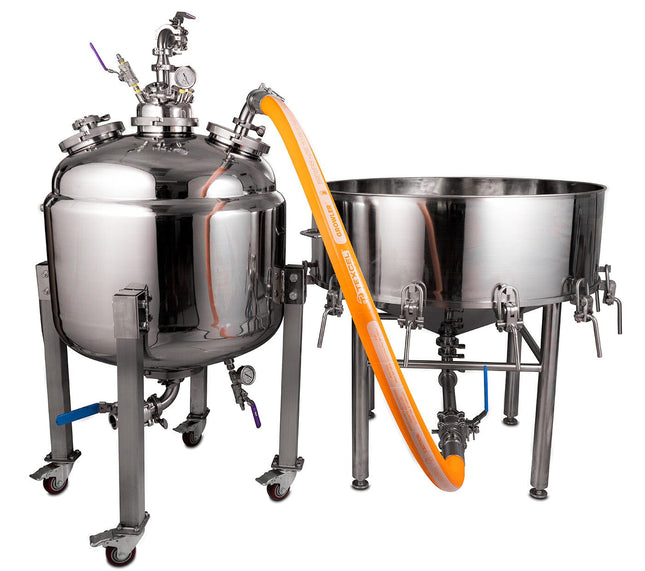

36" Buchner Filtration Kit
Buchner Filtration Kit This filtration kit is operated by using a vacuum pump to pull the solution through the filter paper to remove particulate. The funnel has a 36" perforated plate to support the filter paper. The 150 liter collection vessel has multiple sight glass ports so that you can easily view inside the vessel as well as hold up a flashlight if needed. The standard lid includes a pressure gauge, KF-25 vacuum port, and a valve to release vacuum pressure or add positive pressure to the vessel. The vessel has a surrounding jacket that can be used to heat or cool the solution within the main vessel, it can even be outfitted with a mixer and recovery system if desired! To build your custom setup, talk to our experienced team of account representatives. This kit includes: 36" Filtration Funnel 150L Jacketed Reactor 1.5" Butyl hose Diaphragm vacuum pump (optional)
$9,500.00
-
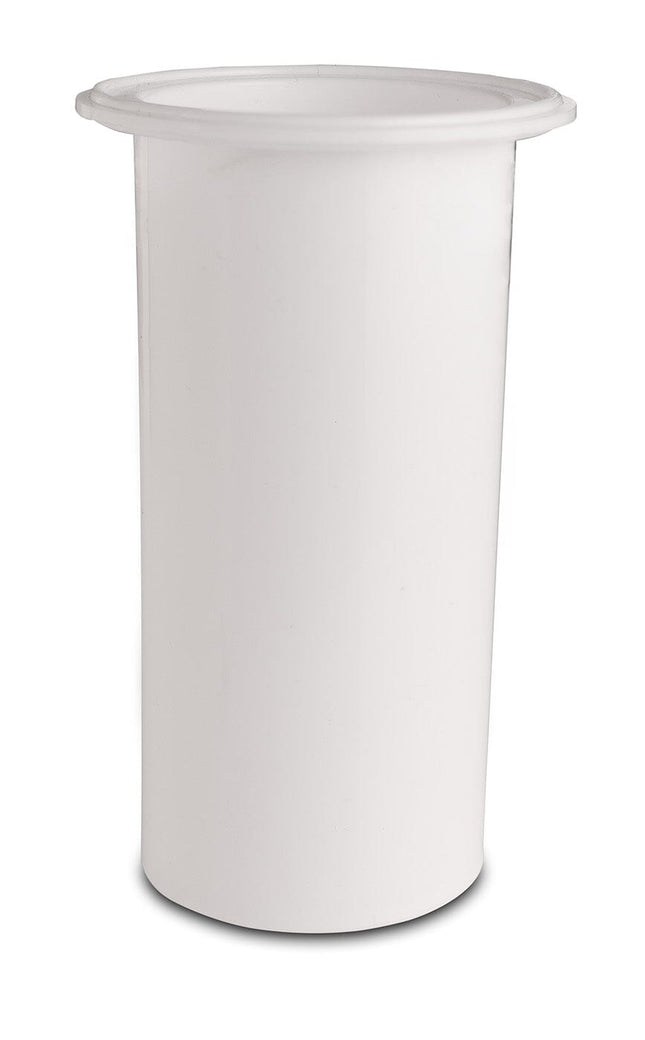

AFS Empty 2.5" CRC Botanical Extraction Filter Cup
2.5" CRC Botanical Extraction Filter Cup
$14.99 $11.00
-
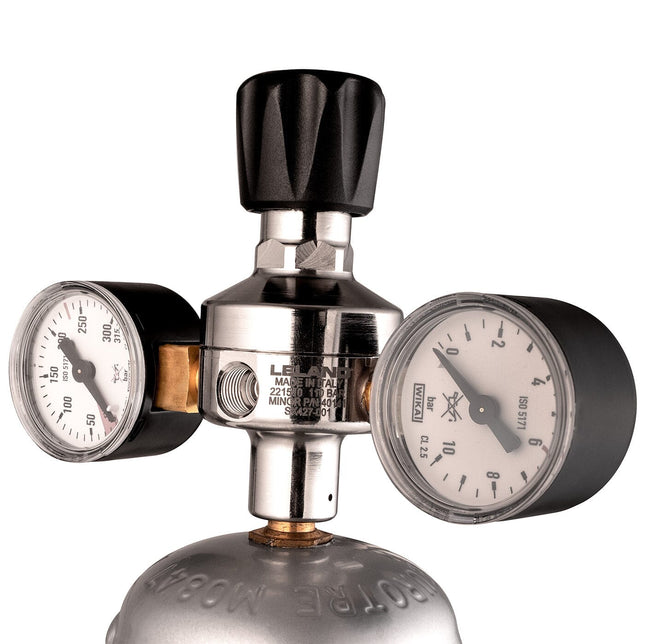

M11x1.0 Regulator for Compressed Gas
Regulator for Compressed Gas Bare Regulator No output Fitting This regulator is designed to fit our compressed gas tanks. Nitrogen, Argon, Helium, Nitrogen & Hydrogen Blend, and Best Whip Nitrous Oxide cylinders. Adjustment knob Is turned on to start gas flow and set desired pressure. Turn clockwise to engages the pin and start the flow of gas. Counterclockwise will retract the pin and stop the flow of gas. Tank Connection: M11x1.0 Output Thread: 1/8" BSPP Made in Italy Regulator Max Pressure Output: 80 PSI Gauges Measure in BAR. Compatible with CO2, Nitrogen, Argon, Nitrogen-Hydrogen mix, Nitrous Oxide and Helium. *The regulator in this listing does not come with hoses, or cylinders or fitting for the output.
$108.00
-
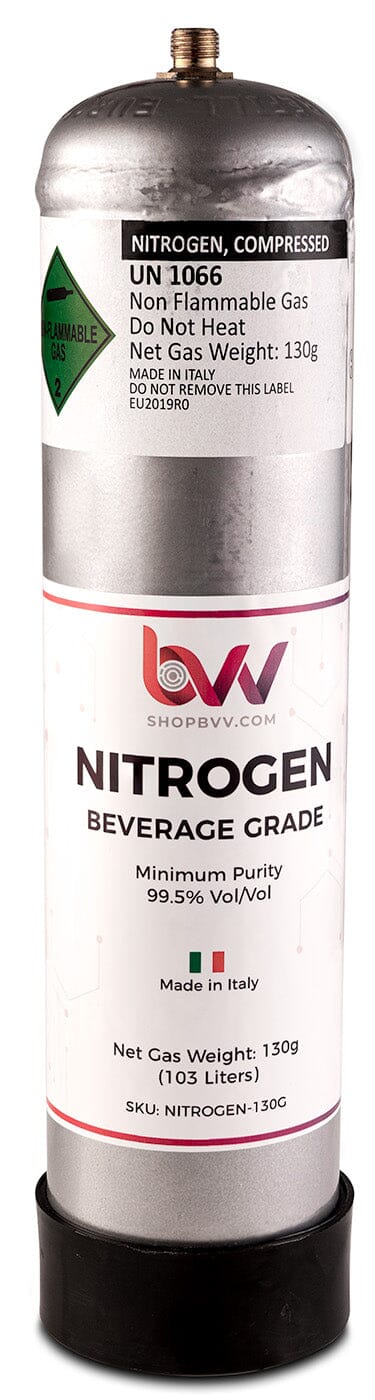

Nitrogen Tank for Extraction 99.5% Pure
Nitrogen Beverage Grade 99.5% Pure Made in Italy This modest but mighty nitrogen tank is a great to pair with any 2lb or smaller extraction system. For those customers that need nitrogen to push their solvent through color remediation columns (CRC) or for those super cold dewax extractions that need the extra push to get the remaining solvent out of the cold columns. This tank will produce a continuous ~66.5 Seconds of Nitrogen @ 80PSI. Directions: (*Hose not Included with regulator) Connect a stainless steel braided 1/4" JIC hose (or vacuum hose BVV-HVAC) to your extractor, placed at the valve where you need your extra pressure push. Using the needle valve you can open the regulator and the nitrogen will flow. Pressurize 15-30PSI. *Note Nitrogen Tank Pressure is 1580 PSI *At end of use, completely empty the tank for recycling. Tank Volume of Nitrogen Coverage Product Sku: 130g / 103 Liters / 3.67 Cubic Feet See Use Chart Below... NITROGEN-130G Regulator/Dispenser Details (not included with tank only purchase) Nitrogen Regulator - Adjustable via. needle valve, regulated to 80 PSI. Made in Italy. Thread: M11x1 (tank connection). Output: 1/4" JIC to connect to any of our 1/4" extractor hoses or vacuum hoses. Gauges read in BAR. M11 Valve Dispenser Kit - Includes adjustable pushpin style valve dispenser. Output: 1/4" JIC Flare, NO GAUGE. Connects to any 1/4" JIC Hose. How long will it last?: A 1lb column of biomass (3"x24") is equal to ~2.7 liters empty. That's about 38 column volumes. Assuming you only used 4 column volumes per extraction you would get ~10 extractions from one tank. Column Size Column Volume # Runs/Tank 1.5x12 (70g biomass column) 0.34 Liters ~75 2x12 (120g biomass column) 0.6 Liters ~54 3x24 (1lb biomass column) 2.7 Liters ~12 4x24 (2lb biomass column) 4.9 Liters ~6 *Use calculated @ 4 column volumes per run What Is Nitrogen Gas? Nitrogen gas is a chemical element and a diatomic molecule with the chemical formula N2. It is a colorless, odorless, and tasteless gas that makes up about 78% of Earth's atmosphere by volume. Nitrogen gas is an essential component of the air we breathe and plays a crucial role in various natural processes and industrial applications. In its gaseous form, nitrogen is composed of two nitrogen atoms tightly bonded together by a strong triple bond. Due to its stable molecular structure, nitrogen gas is relatively inert and does not readily react with other substances under normal conditions. What Is Nitrogen Gas Used For? Nitrogen gas has a wide range of applications across various industries and scientific fields due to its inert nature, abundance, and unique properties. Some of the key uses of nitrogen gas include: Food Preservation: Nitrogen gas is used to create controlled atmospheres in food packaging to extend the shelf life of perishable products. It helps prevent the growth of spoilage microorganisms and maintains the freshness of packaged foods. Laboratory Applications: Nitrogen gas is used in laboratories as a carrier gas for chromatography, as a purge gas to remove oxygen and moisture from sensitive reactions, and for preserving and storing samples. Welding and Metalworking: Nitrogen gas is employed as a shield gas during welding and metalworking processes to prevent oxidation and maintain the integrity of metal surfaces. Electronics Manufacturing: In electronics manufacturing, nitrogen gas is used to create inert environments that prevent oxidation and improve the quality of soldering and component assembly. Cryogenic Applications: Nitrogen gas, when cooled to extremely low temperatures, becomes liquid nitrogen. It is used in cryopreservation of biological samples, freezing and storing biological materials, and in various cryogenic cooling applications. Fire Suppression: Nitrogen gas is utilized as a fire suppressant in certain situations to reduce the concentration of oxygen, effectively suppressing fires and preventing explosions. Oil and Gas Industry: In the oil and gas industry, nitrogen gas is used for pressure testing pipelines, purging equipment, and enhancing oil recovery. Medical and Healthcare: Nitrogen gas is used in medical applications, such as cryotherapy for skin treatments, freezing of warts and lesions, and providing a dry environment for sensitive medical instruments. tAerospace and Aviation: Nitrogen gas is used to pressurize aircraft tires and hydraulic systems, preventing moisture and oxidation-related issues. Fertilizer Production: Nitrogen gas is a key component in the production of ammonia-based fertilizers, which are essential for promoting plant growth in agriculture. Diving Industry: In underwater diving, nitrogen gas is used in breathing gases such as air and nitrox. Pneumatic Systems: Nitrogen gas is used in pneumatic systems for inflating tires, powering tools, and operating machinery. Food and Beverage Industry: Nitrogen gas is used to dispense draft beer, wine, coffee, and other beverages, creating a foamy head and enhancing the presentation. How Can I Pressure Test My Extractor With Nitrogen? Pressure testing your extractor with nitrogen involves using nitrogen gas to check for leaks, verify the integrity of the equipment, and ensure its safety before performing actual extraction processes. Here's a step-by-step guide on how to pressure test your extractor using nitrogen gas: Materials Needed: Nitrogen gas cylinder with appropriate regulator Pressure gauge PTFE tape (thread seal tape) Bubble solution or soapy water Safety goggles and gloves Wrench or spanner Steps: Preparation: Ensure that the extractor is clean and free from any residual materials. Check all fittings, connections, valves, and joints for signs of damage, wear, or corrosion. Replace any damaged components. Make sure the extractor is properly assembled and closed, including any access ports or lids. Safety Precautions: Wear appropriate safety goggles and gloves to protect your eyes and hands. Work in a well-ventilated area to prevent the buildup of nitrogen gas. Regulator Setup: Attach the nitrogen gas cylinder to the regulator and secure it tightly using a wrench. Set the desired pressure on the regulator according to the recommended pressure for your extractor and testing requirements. Sealing Threads: Apply PTFE tape to the threads of the fittings and connections. This helps create a better seal and prevents leaks. Connect Nitrogen Gas: Connect the regulator outlet to the appropriate inlet or access port on the extractor using a compatible hose or tubing. Pressure Testing: Slowly open the nitrogen gas cylinder valve to allow gas to flow into the extractor. Monitor the pressure gauge and allow the pressure to build up to the desired test pressure. Once the desired pressure is reached, close the cylinder valve to stop the flow of nitrogen gas. Leak Detection: If pressure is not maintained apply a bubble solution or soapy water to all the fittings, joints, and connections. Inspect the extractor for any bubbles forming, indicating potential leaks. Pay close attention to areas where bubbles appear, and tighten or adjust fittings after depressurizing the system as needed to eliminate leaks. Release Pressure: Slowly release the pressure from the extractor by gradually opening the cylinder valve. Once the pressure is completely released, disconnect the nitrogen gas source. Final Inspection: Reapply the bubble solution or soapy water to the connections that were adjusted. Verify that no bubbles form, indicating that leaks have been successfully resolved. Documentation: Keep a record of the pressure test results, including the test pressure and any adjustments made. Repeat if Necessary: If any leaks were detected and resolved, repeat the pressure test to ensure all leaks have been eliminated. Pressure testing your extractor with nitrogen gas helps ensure the safety and integrity of the equipment, minimizing the risk of leaks during actual extraction processes. Always follow proper safety guidelines and manufacturer recommendations when working with nitrogen gas and pressure testing equipment. How Do I Perform A Nitrogen Assisted Extraction? Using nitrogen to inject butane into a closed-loop extraction system requires careful consideration and adherence to safety protocols. Nitrogen gas can be used to pressure test the extraction system, assist in transferring butane throughout the system, and assist in the process of adsorbent filtration/color remediation. Here's a step-by-step guide on how to use nitrogen to inject butane into your closed-loop extraction setup: Materials Needed: Closed-loop extraction system with Pressure Relief Valve Nitrogen gas cylinder with appropriate regulator Pressure gauge Nitrogen-compatible hose or tubing Butane tank Butane-compatible hose or tubing Safety goggles and gloves Wrench or spanner Steps: Safety Precautions: Wear appropriate safety goggles and gloves to protect your eyes and hands. Work in a C1D1 environment to prevent the buildup of flammable gases. Preparation: Ensure that the closed-loop extraction system is clean, properly assembled, and free from any residual materials. Regulator Setup: Attach the nitrogen gas cylinder to the regulator and secure it tightly using a wrench. Set the desired pressure on the regulator based on the recommended pressure for your closed-loop system and extraction process We recommend utilizing 25-50 PSI to perform solvent transfer throughout the system. Nitrogen Line Connection: Connect the regulator outlet to the nitrogen-compatible hose or tubing. Connect the other end of the hose to the vapor port or accessory port to the recovery cylinder of your closed-loop system. Butane Line Connection: Connect the recovery cylinder to the closed-loop system using a butane-compatible hose or tubing. Ensure that the recovery cylinder is securely connected to the system, properly sealed, and grounded. Pressurizing the System: Slowly open the nitrogen gas cylinder valve to allow nitrogen gas to flow into pressurize the recovery cylinder. Monitor the pressure gauge and pressurize the recovery cylinder to the desired pressure for injecting butane. Nitrogen gas is used to create pressure that forces the butane into the system. Injecting Butane: Open the valve on the recovery tank to allow the butane to flow into the material column of the closed-loop system. The pressurized nitrogen gas assists in transferring the butane through the system and into the collection base of the system. Monitoring and Safety: Carefully monitor the pressure levels on both the nitrogen gas cylinder and the recovery cylinder. Venting: Once the injection and extraction processes are complete, close the valves on both the nitrogen gas cylinder and the recovery tank. Prior to applying heat to your collection base and starting your solvent recovery procedure first slowly vent the nitrogen from the collection base directly into the ventilation system of your C1D1 Booth. Monitor the pressure gauge and sight glass of the collection base closely. Slowly and incrementally vent the nitrogen from the system until the solution begins to boil this is an indication that the nitrogen filling the headspace of the collection base has been removed and the butane is filling the remaining headspace. Additionally, if the pressure starts to increase after an incremental venting procedure that is a good indication that the nitrogen has been released from the system and the butane is building pressure within the system. If the tank PSI remains the same after a venting procedure then nitrogen is most likely still within the system. Recovery: Once the nitrogen has been successfully removed from the collection base proceed to vent the nitrogen from the empty recovery cylinder and pull the recovery cylinder and the associated lines under vacuum. With the nitrogen now removed from both the collection base and recovery cylinder you can now proceed with your recovery procedure Disconnect the nitrogen gas line and the butane line from the closed-loop system. Properly store the nitrogen gas cylinder and the recovery tank according to safety guidelines. Using nitrogen to inject butane into a closed-loop extraction system requires a solid understanding of the equipment, processes, and safety procedures involved. Always refer to your closed-loop system's manufacturer guidelines and follow best practices for safe operation. How Much Nitrogen Pressure Do I Need For Adsorbent Filtration/ Color Remediation? The nitrogen pressure required for adsorbent filtration and color remediation can vary depending on the specific equipment, setup, and the type of media you are using. It's essential to follow the manufacturer's recommendations for your particular closed-loop extraction system and adsorbent filtration equipment. In general, nitrogen gas can be used to apply pressure to assist in pushing the solvent through the adsorbent media, enhancing the filtration and color remediation process. The pressure you need may vary based on factors such as the viscosity of the solvent, the flow rate, the type of adsorbent media, and the desired results. It's recommended to start with a moderate nitrogen pressure and gradually increase it while monitoring the flow rate and effectiveness of the process. Generally, pressures in the range of 20 to 50 psi (pounds per square inch) are commonly used for adsorbent filtration and color remediation. However, this pressure range can be adjusted based on your specific equipment and requirements. Keep in mind that using too high of a pressure can potentially cause channeling, uneven flow, and limited retention through the adsorbent media, affecting the quality of the filtration process. It's essential to strike a balance between achieving effective filtration and avoiding excessive pressure that could lead to inefficient results or potential safety risks. It's best to perform small-scale tests before scaling up to ensure optimal results and start off slowly when using nitrogen pressure for adsorbent filtration and color remediation. Chemical Formula: N2 Molecular Weight: 28.014 g/mol CAS Registry Number: 7727-37-9 Appearance Colorless Odor: Odorless Density 0.072 lb/ft3 Boiling Point: -196C (-320.8F) Solubility in water: N/A GHS Pictograms: GHS Signal Word: Warning GHS Hazard Statements: H280, H281 GHS Precautionary Statements P282, P336+P317, P403, and P410+P403 UN Identification Number: 1066 Proper Shipping Name: Nitrogen, Compressed Transport Hazard Class: 2.2 Packing Group: None DOT Placard: Nitrogen Safety Data Sheet (SDS)
$41.00 - $158.00
-
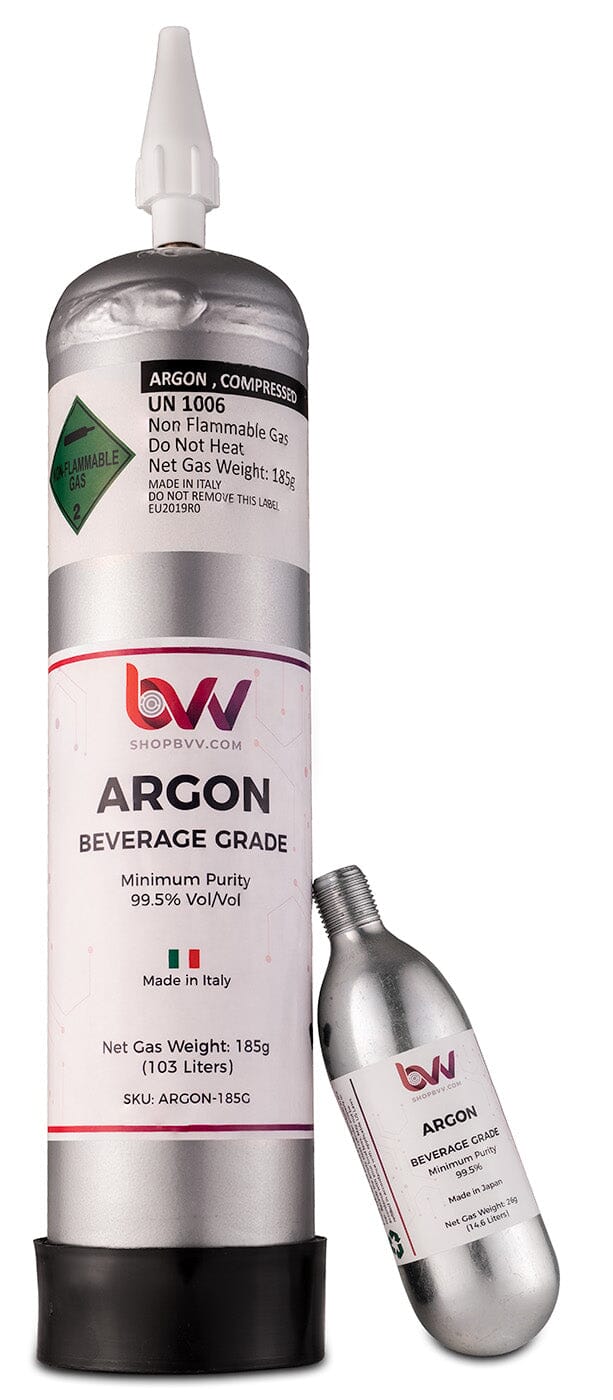

Argon Gas 99.5% - Pure gas for preserving terpenes in flowers and concentrates
Argon Gas Beverage Grade 99.5% Pure Made in Italy Our Pure Argon gas is for preserving terpenes and maximizing shelf life, for flowers and concentrates. The pure argon gas displaces air inside your storage containers, this eliminates oxygen, carbon dioxide and humidity to prevent oxidation of your terpenes and lengthens your shelf life. For the large tank of Argon the gas can be removed using our regulator or valve dispenser that attaches to the top of the tank. Directions: Using an empty container. Point nozzle toward the bottom of your container. Apply 2-seconds per every 4oz of container volume. Immediately fill container with desired material and securely close the lid. *Note Argon is heavier than air, Tank/Cartridge Pressure 1450 PSI Tank Volume of Argon Coverage Product Sku: 26g / 14.6 Liters / 3.8 Gallons ~6.3 lbs of flower ARGON-26G 185g / 103 Liters / 27 Gallons ~31.7 lbs of flower ARGON-130G Regulator Details 14.6 Liters/ with Duster Kit - Thumb touch control button w/ Lock, regulated to 40 PSI. Made in Japan. Thread: 5/8"-18 for use with the 26g Argon Cartridge. 3.5" long nozzle. (Duster Valve can be purchased separately.) 103 Liters/ with Regulator Kit - Adjustable via. needle valve, regulated to 80 PSI. Made in Italy. Thread: M11x1 (tank connection). Output: 1/4" Brass Barb, Includes 12" Tygon Tubing. Gauges read in BAR. 103 Liters/ with M11 Valve Dispenser Kit - Includes adjustable pushpin style valve dispenser. Output: 1/4" Brass Barb, Includes 12" Tygon Tubing. NO GAUGES *All single 130g argon tanks come with a plastic nozzle for general dispensing. If the regulator is beyond your budget you can attach a tube of your choice. Nozzle tip diameter 3/8" - Recommend choosing a 3/8" Inside Diameter tube or larger and cut to your desired length. *At end of use, completely empty the tank for recycling. What Is Argon? Argon is a chemical element with the symbol "Ar" and atomic number 18. It is a noble gas, which means it belongs to a group of inert and colorless gases that are chemically stable and relatively non-reactive under normal conditions. Argon is the third most abundant gas in the Earth's atmosphere, making up about 0.93% of the air we breathe. Despite its abundance, argon is mostly used in specialized industrial applications due to its inert and non-reactive properties. It is obtained as a byproduct of the production of liquid oxygen and liquid nitrogen through the fractional distillation of air. In its natural state, argon is odorless, tasteless, and colorless. What Is Argon Used For? Argon has a variety of practical and industrial uses due to its inert and non-reactive nature. Some of the key applications of argon include: Welding: Argon is commonly used as a shielding gas in welding processes, such as TIG (Tungsten Inert Gas) and MIG (Metal Inert Gas) welding. It helps prevent oxidation and ensures clean and strong welds. Laboratory Research: Argon is used as a carrier gas in gas chromatography and as an inert atmosphere in scientific laboratories to prevent reactions with sensitive materials. Electronics and Semiconductors: Argon is used in the production of semiconductors and other electronic components, providing a controlled environment for manufacturing processes. Preservation of Perishable Goods: In the food and beverage industry, argon is used to displace oxygen and extend the shelf life of perishable goods, such as wine, by preventing oxidation and spoilage. Medical Applications: Argon is employed in laser surgery and serves as a coolant for superconducting magnets in MRI (Magnetic Resonance Imaging) machines. Deep-Sea Diving: Argon-helium mixtures are used in deep-sea diving to reduce the effects of high pressure on the human body. Lighting: Although less common now, argon was used in incandescent light bulbs to prevent the filament from oxidizing. Metal Manufacturing: Argon is used in the production of metals like titanium and other reactive metals to create a controlled atmosphere. Heat Treating: In heat-treating processes, argon is used as a protective atmosphere to prevent oxidation and maintain the desired material properties. Window Insulation: Argon is sometimes used to fill the space between double or triple-pane windows to improve insulation and energy efficiency. Astronomy: Argon is used in some types of telescopes to create a stable and controlled environment for the detectors. These applications highlight the versatility of argon in various industries, where its inertness and non-reactivity play a crucial role in maintaining controlled and stable conditions for specific processes. How Does Argon Preserve Terpenes? Argon can be used to preserve terpenes through its inert and non-reactive properties. Terpenes are volatile organic compounds responsible for the aroma and flavor of various plants. When exposed to oxygen or other reactive gases, terpenes can degrade or oxidize, leading to a loss of their aromatic and flavor characteristics. By using argon as a protective gas, you can create an oxygen-free environment that prevents terpenes from coming into contact with reactive molecules. This helps to preserve the integrity of terpenes and maintain their original aroma and flavor profiles. When storing or handling terpene-rich products, such as essential oils or botanical extracts, introducing argon gas can help extend the shelf life and ensure that the product retains its desirable sensory attributes. Argon's inert nature means it does not chemically interact with the terpenes, preventing unwanted reactions that could lead to degradation. It forms a barrier between the terpenes and the surrounding air, effectively shielding them from oxygen and moisture, both of which can contribute to terpene degradation. Argon can be a valuable tool for terpene preservation during storage, Helping you preserve the unique terpene profiles of different strains making it crucial for maintaining product quality. How Does Argon Displace Oxygen? Argon displaces oxygen through a process called inert gas displacement or dilution. This occurs when argon, which is denser than air, is introduced into an enclosed space, pushing the lighter oxygen molecules upward and out of the area. As a result, the concentration of oxygen in the space decreases, creating an atmosphere that is less conducive to combustion and other chemical reactions. Here's how the displacement process works: Density Difference: Argon is significantly denser than air, which means it has a higher mass per unit volume. When argon is released into an enclosed space, it naturally sinks to the bottom, displacing the lighter gases like oxygen and nitrogen that make up the atmosphere. Mixing: As argon is introduced, it starts to mix with the existing air in the space. The heavier argon molecules tend to concentrate near the bottom, while the lighter oxygen molecules rise to the top. Oxygen Reduction: As argon continues to fill the space, the concentration of oxygen molecules decreases. Oxygen is gradually pushed upward and out of the area, leading to a lower oxygen content in the atmosphere. Inert Environment: The increasing presence of argon creates an inert environment where oxygen is less available to support oxidation. This is particularly useful in storing oxidizable compounds. It's important to note that while argon displaces oxygen, it does not chemically react with other gases or substances. Instead, it creates a physical barrier between oxygen and the materials that could ignite or react with it. This property makes argon a valuable tool in fire suppression systems, as well as in applications like food preservation, where a low-oxygen environment helps extend the shelf life of products. When working with argon, especially in confined spaces, proper safety measures should be followed to prevent oxygen depletion and ensure a safe working environment. How Do I Use Argon For Flower and Concentrate Storage? Using argon for flower and concentrate storage is a simple and effective method to help preserve the quality and freshness of your products. Follow these steps to properly use argon gas for storage: Prepare the Container: Start with a clean and empty container that is suitable for storing your flower or concentrate. Ensure that the container has a tight-fitting lid or cap to create a sealed environment. Position the Nozzle: Hold the argon gas canister with the nozzle pointing toward the bottom of the container. This helps ensure that the argon gas displaces any oxygen present in the container. Apply Argon Gas: Press the nozzle to release the argon gas into the container. The recommended dosage is approximately 2 seconds of spraying for every 4 ounces of container volume. This dosage helps create a protective layer of argon gas within the container. Fill the Container: Immediately after applying the argon gas, place your desired flower or concentrate into the container. The argon gas will create a blanket of protection over the material, minimizing its exposure to oxygen. Securely Close the Lid: Once the container is filled with the material, seal it tightly with the lid or cap. Make sure the container is properly closed to maintain the sealed environment. Store in a Cool, Dark Place: Store the sealed container in a cool, dark place to further protect the contents from light and heat. Proper storage conditions are essential for maintaining the quality and potency of your flower or concentrate. Using argon gas in this manner helps create an oxygen-free atmosphere within the container, reducing the risk of oxidation and degradation of your products. By minimizing oxygen exposure, you can extend the shelf life and preserve the flavors, aromas, and potency of your flower and concentrate. Remember to always follow safety precautions when handling argon gas, including proper ventilation and avoiding direct inhalation. Additionally, ensure that the argon gas canister is stored and used in accordance with manufacturer guidelines. How Can I Preserve Wine With Argon? Preserving wine with argon is a popular method to extend the shelf life of opened bottles and maintain the wine's freshness and flavor. Follow these steps to effectively use argon gas for wine preservation: Gather the Necessary Equipment: Argon gas canister with a preservation nozzle or wine preservation system An opened bottle of wine with a cork or closure Position the Nozzle: Insert the dispensing line or nozzel into the neck of the wine bottle. If using an argon gas canister with a preservation nozzle, insert the nozzle into the bottle's neck, ensuring a tight fit. If using a wine preservation system, follow the manufacturer's instructions for attaching the system to the bottle. Apply Argon Gas: Press the nozzle to release a short burst of argon gas into the bottle. The argon gas is heavier than air and will displace the oxygen present in the bottle, creating a protective layer on top of the wine. Recap or Recork: Immediately after applying the argon gas, recap the bottle with its original cork or closure. Make sure the closure is securely in place to maintain a seal. Store the Bottle: Store the wine bottle upright in a cool and dark place, away from direct sunlight and temperature fluctuations. Enjoy Over Time: When you're ready to enjoy the wine again, simply remove the closure and pour a glass. The argon gas layer will have helped protect the wine from oxidation, allowing you to savor the wine's original flavors and aromas. It's important to note that argon gas is denser than air, so it will naturally settle on top of the wine. This layer of argon forms a barrier between the wine and the oxygen, preventing oxidation and preserving the wine's quality. Using argon gas for wine preservation is a convenient and effective method to enjoy opened bottles of wine over an extended period. It's particularly useful for wines that are meant to be enjoyed gradually, as well as for special bottles that you want to savor over time without worrying about deterioration. Always follow the manufacturer's guidelines for using argon gas for wine preservation and handle the gas canister with care. Chemical Formula: Ar Molecular Weight: 39.9 g/mol CAS Registry Number: 7440-37-1 Appearance Colorless Odor: Odorless Density 0.103 lb/ft3 Boiling Point: N/A Solubility in water: N/A GHS Pictograms: GHS Signal Word: Warning GHS Hazard Statements: H280, H281 GHS Precautionary Statements P282, P336+P317, P403, and P410+P403 UN Identification Number: 1006 Proper Shipping Name: Argon, Compressed Transport Hazard Class: 2.2 Packing Group: None DOT Placard: Argon Safety Data Sheet (SDS)
$16.50 - $167.00
-
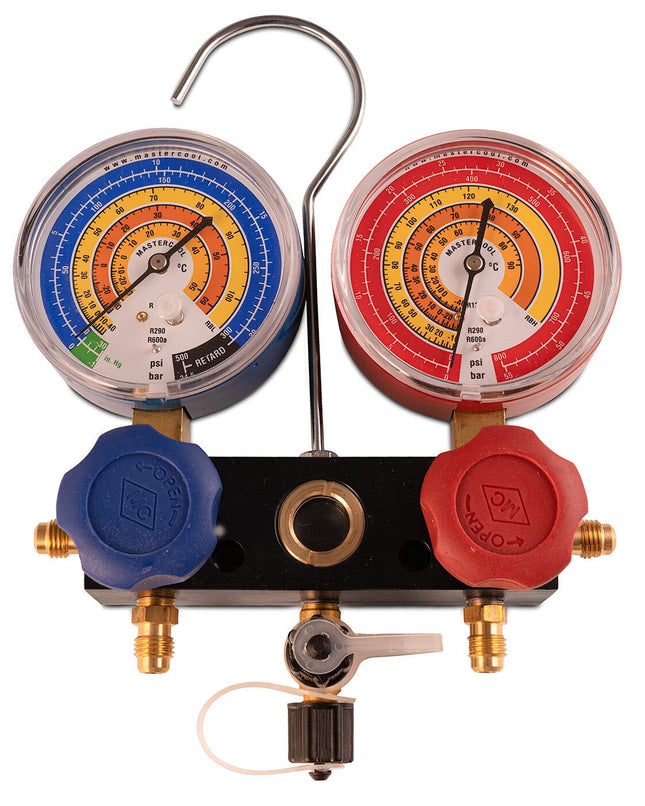

Mastercool Mastercool Manifold
Mastercool Manifold Mastercool Aluminum R12 Manifold: THE MASTERCOOL MANIFOLD IS USED IN CONJUCTION WITH BOTH OUR ACTIVE UPGRADE KIT AND OUR ICARUS RACK SYSTEMS. WHEN USED IN AN ACTIVE CLOSED LOOP RECOVERY/CIRCULATION KIT, THE MANIFOLD ALLOWS FOR CONTROL OF SOLVENT INPUT VIA EXTRACTOR INPUT ON THE LOW SIDE(BLUE GAUGE), AND RECOVERY TO YOUR SUPPLY TANK ON THE HIGH SIDE (RED GAUGE). WHEN USED WITH ONE OF OUR ICARUS RACK SYSTEMS, THE MIDDLE PORT IS CONNECTED TO A SEPERATE NITROGEN SUPPLY TANK, AND THE HIGH AND LOW SIDES ARE CONNECTED TO THE MATERIAL COLUMN AND DEWAXER TO PROVIDE PASSIVE PRESSURE ASSISTANCE FOR MOVING SOLVENT THROUGH THE SYSTEM. Mastercool is the leading manufacturer of professional quality A/C manifold gauge sets. Our manifold gauge sets are. Constructed of the finest materials and machined with precision to the highest quality standards. At Mastercool, everymanifold we build is built to last. All Mastercool gauges are color coordinated for easy refrigerant recognition. Our free floating piston valve results in less wear and tear in comparison to market standard twisting piston valves Double O-Ring allows for a much better seal resulting in less leaks SPECIFICATIONS: Aluminum Block ¼ SAE Brass Fittings 1.6 Gauge Class 80 mm Gauges Refrigerants: R1270, R290, R600a Bar, PSI, ˚C Temp. Ratings: 100˚C Pressure Ratings: High Side 800 PSI, Low Side 500 PSI Temp.: Different for each Refrigerant
$75.00
-
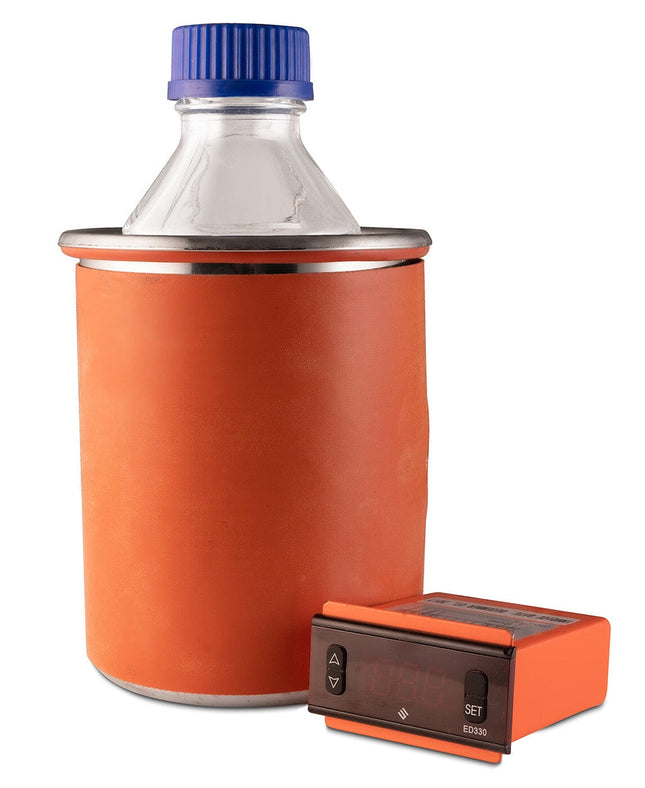

BVV Bead Bath
BVV Bead Bath Introducing the BVV's Bead Bath - A cost-effective Bead Bath for Precise and Contamination-Free Laboratory needs. The Bead Bath is a cost-effective bead bath that allows for precise temperature application to warm your extracts, distillates, and isolates faster than a traditional hot plate eliminating water contamination. Unlike traditional water baths, bead baths replace water with reusable metallic beads, eliminating the risk of experimental contamination and ensuring accurate results. With the Bead Bath, you can say goodbye to high electricity consumption and frequent cleanup. The bead bath's efficient design minimizes power usage, as the beads do not evaporate, and require less maintenance, saving you time and resources. Experience rapid start-up times and uniform heating with the Bead Bath's surround heating feature. This cutting-edge technology guarantees even temperature distribution, preventing hotspots and ensuring consistent and reliable outcomes for your samples. Safety is our top priority, and the Bead Bath is no exception. Equipped with over-temperature protection, this bead bath maintains safe and stable conditions for your valuable samples throughout the entire experiment. Discover the benefits of the BVV Bead bath and revolutionize your laboratory work with contamination-free, precise, and efficient temperature control. Join researchers and professionals worldwide in experiencing the power of the #1 bead bath ranked on Google. Upgrade your experiments with the BVV's Bead Bath. Bath internal dimensions: 2 quart: 6.75” Tall X 4.75” Diameter 1.5 Gallon: 8-5/8" Tall x 7-1/8" Diameter 3 Gallon: 9" Tall x 10" Diameter 7 Gallon: 8" Tall x 16" Diameter Does not include Beads If the option is selected to include aluminum beads, the quantities will be: 2 quart: 2 liters 1.5 Gallon: 4 liters 3 Gallon: 9 liters 7 Gallon: 18 liters
$130.00 - $2,075.00
-
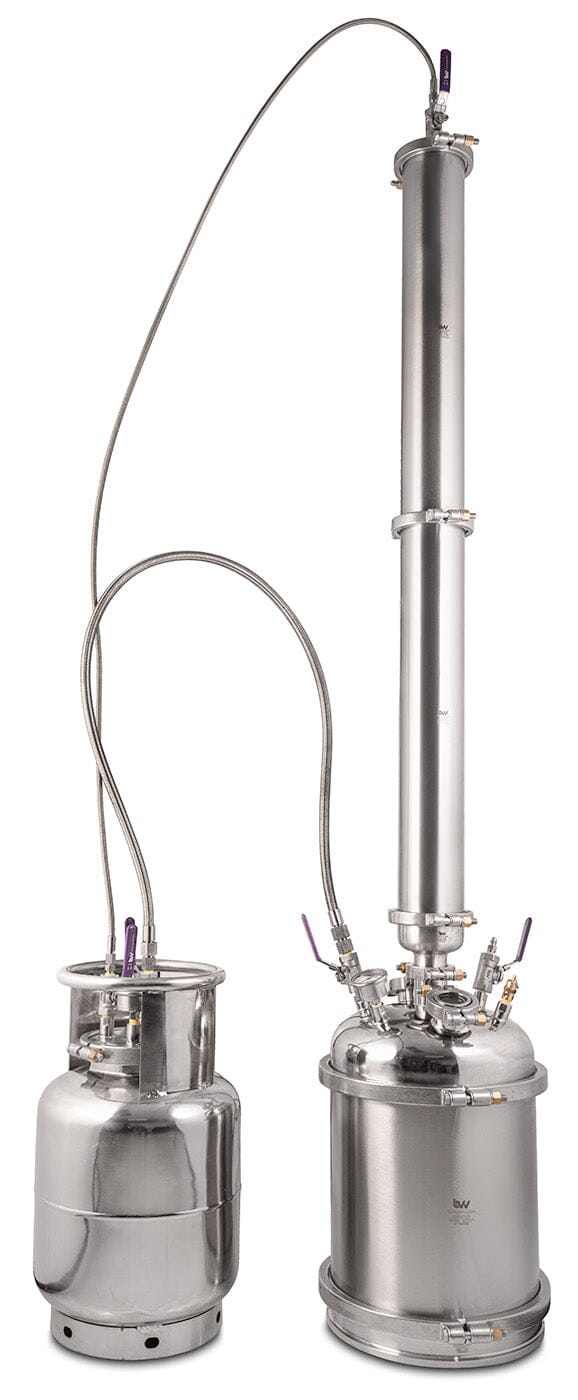
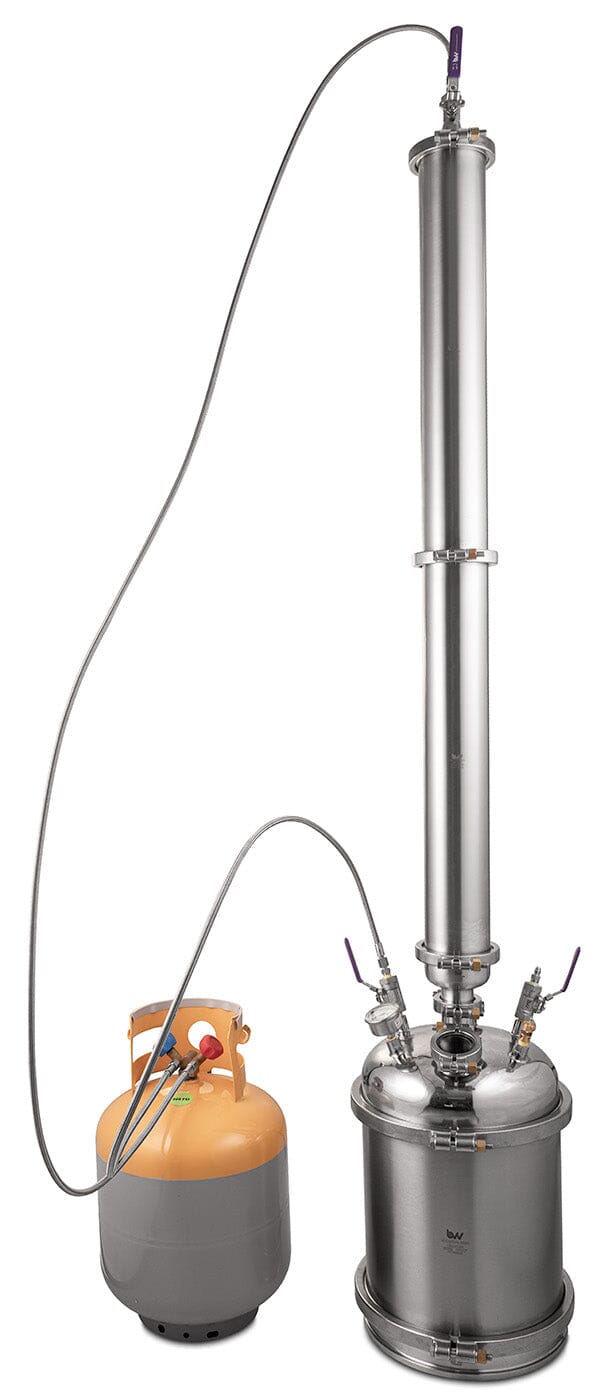
5LB TFX Closed Loop Extractor
5LB TFX Closed Loop Extractor Are you ready to embark on an exciting journey into the world of extraction? Look no further than the TFX – your ultimate entryway into the realm of closed-loop extraction. The TFX not only offers exceptional performance straight out of the box at an affordable price but also serves as a dynamic foundation for future upgrades and enhancements, allowing you to elevate your extraction prowess over time. Whether you're just starting your extraction venture or seeking to amplify your capabilities, the TFX provides a sturdy base that can be tailored to meet your evolving requirements. With its adaptable design and compatibility with various upgrades, the TFX empowers you to experiment with novel processing techniques and adapt to the ever-changing demands of the industry. Initiate your journey with the TFX and unlock boundless possibilities for innovation and expansion in the extraction domain. Introducing the TFX closed-loop extractor – the evolution of the popular Apollo extractor. The TFX heralds a new era of safety, user-friendliness, and performance. Building upon the achievements of its predecessor, the TFX takes operator safety to new heights, featuring enhanced safety mechanisms such as High-pressure Clamps and pressure relief valves as standard features. Harvesting extracts is made effortless with splatter platter bases, ensuring a cleaner and more seamless process. The optimized design of the TFX translates to heightened ease of use, safety, and performance, resulting in top-tier extracts. The TFX stands as the cornerstone of many extractors' journeys, providing a reliable, efficient, and future-proof solution to meet your evolving demands. The TFX closed-loop extractor comes in three model variants, tailored to different extraction needs. The V1 Explorer is the ideal choice for those mindful of their budget, offering an affordable entry point into the extraction world. Equipped with features like a DOT-Approved carbon steel recovery tank, 1/4" JIC Recovery lines, and polycarbonate sight glasses, it establishes the groundwork for seamless future upgrades. For those seeking a professional setup from the outset, the V2 Professional model is the prime selection. It boasts an upgraded stainless steel recovery tank with 1/2" JIC Recovery lines for optimal solvent recovery. Enhanced borosilicate sight glasses provide improved visibility during the extraction process. For the ultimate extraction experience, the V3 Elite model is your answer. It encompasses all the upgrades of the professional variant, along with additional features such as a solvent dispersal plate for uniform biomass saturation and a jacketed splatter platter compatible with a heated circulator, enhancing solvent recovery efficiency. The TFX closed-loop extractor empowers you to choose the model that suits your budget and needs perfectly. Whether you're taking your first steps or aiming for professional-grade capabilities, the TFX series lays the groundwork for your extraction journey. Regardless of your choice – Explorer, Professional, or Elite – the TFX closed-loop extractor offers endless modification possibilities to amplify your capabilities and remain ahead of industry trends. Tailored for quick wash extraction procedures, the TFX guarantees outstanding purity and yield. For those inclined towards soaking procedures, a simple addition of our 316L SS Tri-Clamp Ball Valve beneath the material column transforms the TFX. For utmost purity, pair your TFX with an Inline CRC (Color Remediation Column) to achieve the highest quality and purest extracts. Planning to work with fresh frozen material? Swap out the standard 4"x 24" spools for Sleeved Spools to preserve the biomass's flavor during extraction. To attain unparalleled clarity in your extracts, reduce wax content by integrating an injection coil into your setup. To enhance solvent recovery efficiency and minimize loss, consider adding our BVV 2 Cylinder Active Closed Loop Recovery kit to your TFX closed-loop extractor. This kit optimizes solvent recovery, ultimately saving you valuable time and resources. With the TFX closed-loop extractor and its range of modification options, you have the freedom to tailor your extraction setup to match your distinct requirements. Stay at the forefront of the industry and unlock the full potential of your extraction process with the versatile TFX closed-loop extractor. As a prominent manufacturer of extraction equipment, we prioritize precision and safety in the extraction process. The TFX embodies these principles, offering a state-of-the-art solution for extraction professionals. Engineered from high-quality stainless steel, the TFX guarantees exceptional durability and corrosion resistance, providing you with a dependable and enduring extraction solution. Its innovative design integrates advanced safety features such as high-pressure clamps, pressure relief valves, and sight glasses, ensuring operator well-being and operational control. Its superior design promotes efficient solvent flow and comprehensive material saturation, resulting in high-quality, potent extracts that meet your specific requirements. When it comes to introductory closed-loop extractors, the TFX sets a new benchmark with its exceptional performance, safety features, and reliability. With our product, you can streamline your extraction operations, amplify productivity, and craft premium extracts that surpass industry standards. At BVV, we take pride in offering top-tier extraction equipment tailored to your unique needs. Our team of experts is devoted to providing unparalleled customer support, assisting you every step of the way, from your initial purchase to setup and beyond. Elevate your butane extraction experience with the TFX – the definitive top-fill closed-loop extractor. Reach out to us today to initiate your extraction journey and propel your business to new heights. Specifications 2X 4"x24" 1LB Material Column 12"x12" Collection Base Body 12" Collection Base Splatter Platter 100um Nitrile BUNA-N Mesh Gaskets 1.5" Polycarbonate or Borosilicate Sight Glasses 125 PSI ASME Safety Valves -30hg-250PSI Compound Pressure Gauge 1/4" or 1/2" Full Bore Recovery Lines 1/4" JIC process Flow lines Explorer Professional Elite DOT Carbon Steel Solvent Tank Polycarbonate Sight Glasses 1/4" JIC Recovery Lines Stainless Steel Solvent Tank Borosilicate Sight Glasses 1/2" JIC Recovery Lines Stainless Steel Solvent Tank Borosilicate Sight Glasses 1/2" JIC Recovery Lines Solvent Dispersal Plate Jacketed Splatter Platter ***Note: Solvent not included with systems unless ordered separately. Any order with butane WILL NOT SHIP EXPEDITED.*** ***DISCLAIMER: This unit is intended for LEGAL purposes only, to be used in accordance with local laws and ordinances. Use only in extremely well-ventilated areas. Check with your local fire marshal for guidance when operating indoors. *Note: Column capacity may vary depending on the density of packed material and packing density. Capacity is calculated using the industry standard of 4.2g/in3. This is the upper limit for column capacity. Low density, uncut, and/or lightly packed material can reduce capacity by 50%. For best results, we recommend to tightly pack coarse ground material.
$1,750.00 - $2,825.00
-
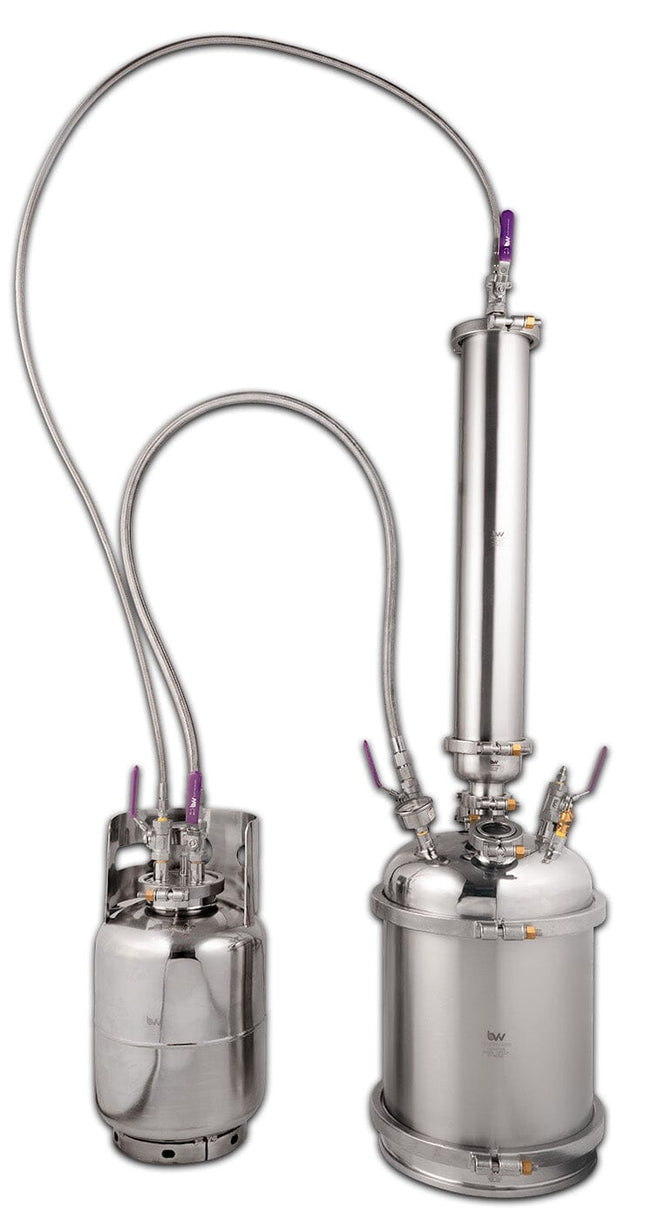
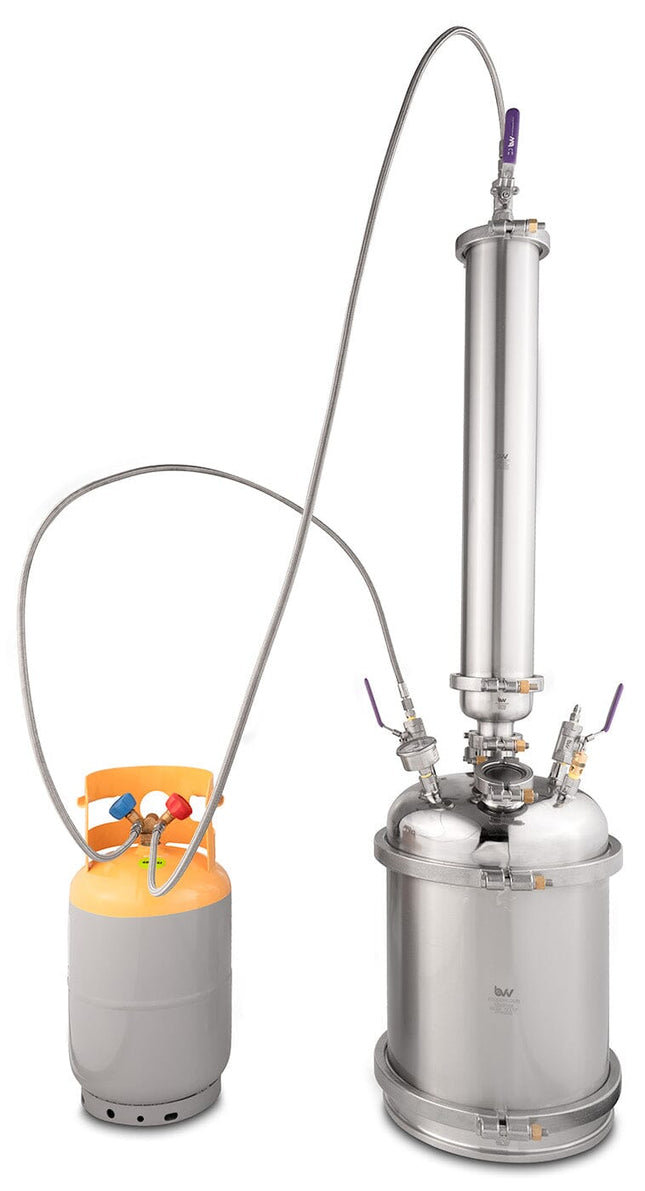
2LB TFX Closed Loop Extractor
2LB TFX Closed Loop Extractor Are you ready to embark on an exciting journey into the world of extraction? Look no further than the TFX, your perfect entry point into the world of closed-loop extraction. The TFX offers exceptional performance right out of the box at an affordable price, making it an excellent choice for both beginners and experienced extractors. But that's not all – the TFX also serves as a versatile foundation for future upgrades and enhancements, allowing you to level up your extraction game over time. Whether you're just starting or aiming to expand your capabilities, the TFX provides a solid base that can be customized to meet your evolving needs. With its adaptable design and compatibility with various upgrades, the TFX empowers you to experiment with new processing techniques and adapt to changing industry demands. Begin your journey with the TFX and open the door to endless possibilities for innovation and growth in the extraction realm. Introducing the TFX closed-loop extractor, the next step in the evolution of the popular Apollo extractor. The TFX brings a new era of safety, user-friendliness, and performance to the table. Building on the success of its predecessor, the TFX takes operator safety to the next level with enhanced safety mechanisms, including High-pressure Clamps and pressure relief valves as standard features. Extract harvesting is made easier with splatter platter bases, ensuring a cleaner and smoother process. The TFX's optimized design translates to improved ease of use, safety, and performance, resulting in top-quality extracts. The TFX is the cornerstone of many extractors' journeys, offering a reliable, efficient, and future-ready solution to meet your evolving needs. The TFX closed-loop extractor comes in three model variants, catering to different extraction requirements. The V1 Explorer is the choice for budget-conscious individuals looking to enter the world of extraction affordably. With features like a DOT-Approved carbon steel recovery tank, 1/4" JIC Recovery lines, and polycarbonate sight glasses, it lays the foundation for easy future upgrades. For those seeking a professional setup from the start, the V2 Professional model is the ideal option. It comes with an upgraded stainless steel recovery tank featuring 1/2" JIC Recovery lines for optimized solvent recovery. Enhanced borosilicate sight glasses provide better visibility during the extraction process. If you're aiming for the ultimate extraction experience, the V3 Elite model is the answer. This model includes all the upgrades of the professional variant, along with additional features like a solvent dispersal plate for uniform biomass saturation and a jacketed splatter platter for use with a heated circulator, improving solvent recovery efficiency. The TFX closed-loop extractor lets you choose the perfect model for your budget and needs. Whether you're starting small or aiming for professional-grade capabilities, the TFX series provides the perfect foundation for your extraction journey. No matter which model you choose – Explorer, Professional, or Elite – the TFX closed-loop extractor offers limitless modification possibilities to enhance your capabilities and stay ahead of industry trends. Optimized for quick wash extraction procedures, the TFX ensures exceptional purity and yield. If you prefer soaking procedures, simply add our 316L SS Tri-Clamp Ball Valve below the material column to adapt the TFX. For the utmost purity, pair your TFX with an Inline CRC (Color Remediation Column) for the highest quality and purest extracts. Running fresh frozen material? Swap the standard 4"x 24" spool with a Sleeved Spool to preserve your biomass's flavor during extraction. To achieve ultimate clarity, reduce wax content by incorporating an injection coil into your setup. To enhance solvent recovery and reduce loss, consider our BVV 2 Cylinder Active Closed Loop Recovery kit for your TFX closed-loop extractor. This kit boosts solvent recovery efficiency, saving you time and resources. With the TFX closed-loop extractor and its range of modification options, you have the freedom to customize your extraction setup to match your unique needs. Stay at the forefront of the industry and unlock your extraction process's full potential with the versatile TFX closed-loop extractor. As a premier extraction equipment manufacturer, we prioritize precision and safety in the extraction process. The TFX is designed with these principles in mind, offering a cutting-edge solution for extraction professionals. Constructed from high-quality stainless steel, the TFX ensures exceptional durability and resistance to corrosion, providing you with a reliable and long-lasting extraction solution. Its innovative design incorporates advanced safety features, including high-pressure clamps, pressure relief valves, and sight glasses, ensuring operator well-being and operational control. Its superior design promotes efficient solvent flow and comprehensive material saturation, resulting in high-quality, potent extracts that meet your precise requirements. When it comes to introductory closed-loop extractors, the TFX sets a new standard with its exceptional performance, safety features, and reliability. With our product, you can streamline extraction operations, boost productivity, and produce premium extracts that surpass industry standards. At BVV, we take pride in offering top-tier extraction equipment tailored to your unique needs. Our team of experts is dedicated to providing unmatched customer support, assisting your extraction journey and take your business to new heights. Specifications 4"x24" 1LB Material Column 12"x12" Collection Base Body 12" Collection Base Splatter Platter 100um Nitrile BUNA-N Mesh Gaskets 1.5" Polycarbonate or Borosilicate Sight Glasses 125 PSI ASME Safety Valves -30hg-250PSI Compound Pressure Gauge 1/4" or 1/2" Full Bore Recovery Lines 1/4" JIC process Flow lines Explorer Professional Elite DOT Carbon Steel Solvent Tank Polycarbonate Sight Glasses 1/4" JIC Recovery Lines Stainless Steel Solvent Tank Borosilicate Sight Glasses 1/2" JIC Recovery Lines Stainless Steel Solvent Tank Borosilicate Sight Glasses 1/2" JIC Recovery Lines Solvent Dispersal Plate Jacketed Splatter Platter ***Note: Solvent not included with systems unless ordered separately. Any order with butane WILL NOT SHIP EXPEDITED.*** ***DISCLAIMER: This unit is intended for LEGAL purposes only, to be used in accordance with local laws and ordinances. Use only in extremely well-ventilated areas. Check with your local fire marshal for guidance when operating indoors. *Note: Column capacity may vary depending on the density of packed material and packing density. Capacity is calculated using the industry standard of 4.2g/in3. This is the upper limit for column capacity. Low density, uncut, and/or lightly packed material can reduce capacity by 50%. For best results, we recommend to tightly pack coarse ground material.
$1,625.00 - $2,425.00
-
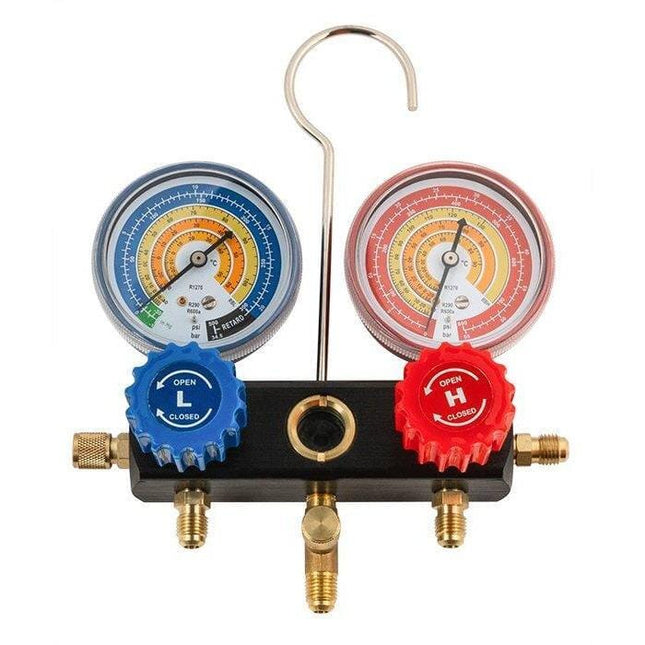

Pro Series Manifold
Pro Series Manifold with Charging Hose Set R290/R600 This manifold is designed for R290 and R600 Propane and Butane solvents for closed loop extraction systems and for nitrogen assistance to push solvent through the system. When used in an active closed loop recovery and circulation system, the manifold allows the user to control the solvent input via the manifold through the gauges and allows you to monitor the pressure and vacuum of the system while it is running. Specifications: Aluminum Block Body 1/4" SAE Brass Fittings 60mm Gauges Refrigerants: R1270/R290/R600a BAR, PSI, Celsius Temp. Ratings: 100C Pressure Ratings: 800PSI High Side, 500PSI Low Side Includes 3 Multi-Colored Charging Hoses.
$35.00 - $45.00
-
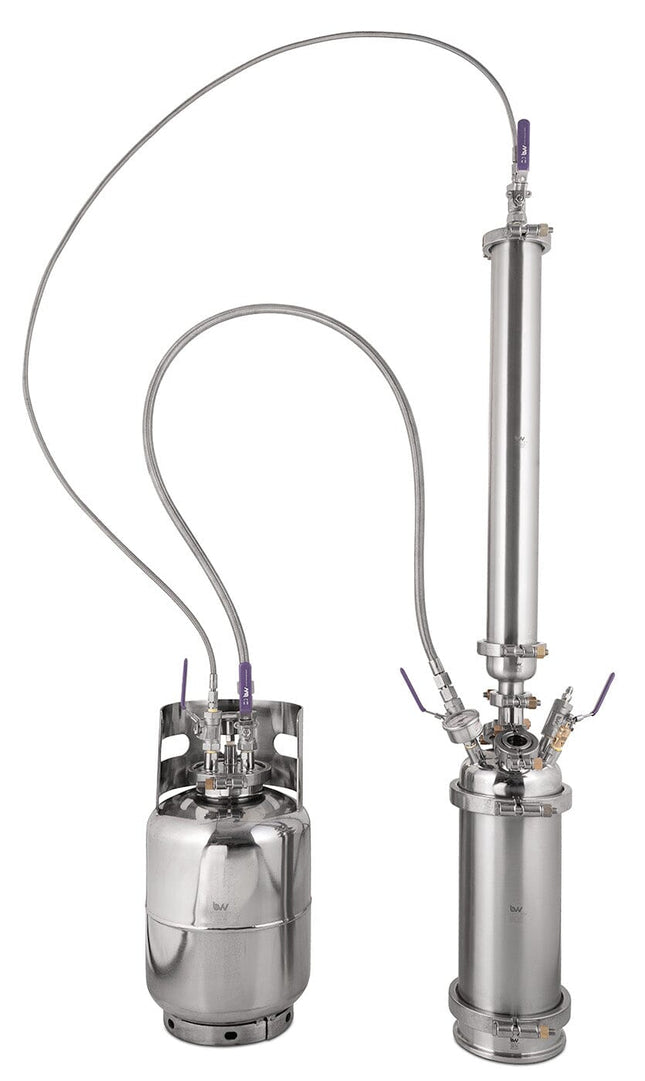

1LB TFX Closed Loop Extractor
1LB TFX Closed Loop Extractor Are you ready to embark on your extraction journey? Look no further than the TFX, the perfect introductory closed-loop extractor to kickstart your extraction journey. Not only does the TFX deliver exceptional performance at an affordable price right out of the box, but it also serves as an excellent base unit for future upgrades and modifications as level up your extraction game. Whether you're just starting or looking to expand your capabilities, the TFX provides a solid foundation that allows you to tailor your extraction setup to meet your evolving needs. With its versatile design and compatibility with various extractor upgrades, the TFX empowers you to explore new processing techniques and adapt to changing industry demands. Begin your extraction journey with the TFX, and unlock limitless possibilities for innovation and growth in the world of extraction. The TFX closed loop extractor represents the evolution of the highly popular Apollo closed loop extractor, introducing a new era of enhanced safety, ease of use, and performance. Building upon the success of its predecessor, the TFX provides greater safety, ease of use, and performance. Designed with operator safety in mind, the TFX incorporates improved safety mechanisms, including High-pressure Clamps and pressure relief valves standard to ensure maximum safety during the extraction process. Furthermore, the TFX line of closed-loop extractors makes extract harvesting a breeze with splatter platter bases standard. Its optimized design results in superior ease of use, performance, and safety yielding exceptional quality extracts. The TFX closed-loop extractor represents the foundation of most extractors' journey, providing would-be professionals and established professionals alike with a reliable, efficient, and future-proof solution to meet their evolving needs. The TFX line of closed-loop extractors is available in three distinct model variants to suit various extraction needs. The V1 Explorer is the ideal choice for budget-conscious individuals seeking an affordable entry-level option to venture into the world of extraction. This model features a DOT-Approved carbon steel recovery tank, 1/4" JIC Recovery lines, and polycarbonate sight glasses, providing a solid foundation that can be easily upgraded to professional or elite options in the future. For those aiming for a professional setup from the start, the V2 Professional model is the way to go. It includes an upgraded stainless steel recovery tank with 1/2" JIC Recovery lines, ensuring optimized solvent recovery. Additionally, the professional model includes upgraded borosilicate sight glasses, enhancing the visibility of the extraction process. If you're seeking the ultimate extraction experience, the V3 Elite model is your go-to solution. It incorporates all the upgrades of the professional model, including the upgraded stainless steel recovery tank with 1/2" JIC Recovery lines and upgraded borosilicate sight glasses. Moreover, the elite model goes beyond by featuring a solvent dispersal plate for even biomass saturation and a jacketed splatter platter for use with a heated circulator to ditch the hot water bath and further optimize solvent recovery. The TFX closed-loop extractor empowers you to choose the perfect model that suits your budget and requirements, Whether you're starting out or aiming for professional-grade capabilities the TFX Closed Loop Extractor series is the perfect foundation to start your extraction journey. Whether you opt for the Explorer, Professional, or Elite model, the TFX line of closed-loop extractors offers infinite modification possibilities to expand your capabilities and stay ahead of the evolving needs of the industry. While the TFX is specifically optimized for quick wash extraction procedures, ensuring exceptional purity and yield. It can easily be adapted for soaking procedures by adding our 316L SS Tri-Clamp Ball Valve below the material column. For those seeking absolute purity, pairing your TFX with an Inline CRC (Color Remediation Column) allows you to create the highest quality and purest extracts imaginable. If running fresh frozen material is your goal, simply swap out the standard 3"x 24" spool with a Sleeved Spool to chill your material during the extraction process and preserve the flavor of your starting biomass. To achieve absolute clarity in your extracts, reduce wax content by incorporating an injection coil into your setup. If you're looking to reduce solvent loss and improve recovery times, consider adding our BVV 2 Cylinder Active Closed Loop Recovery kit to your TFX closed loop extractor. This kit enhances solvent recovery efficiency, ultimately saving you time and resources. With the TFX closed loop extractor and its extensive range of modification options, you have the freedom to customize your extraction setup to meet your unique requirements. Stay at the forefront of the industry and unlock the full potential of your extraction process with the versatile TFX closed-loop extractor. As a leading manufacturer of extraction equipment, we understand the importance of precision and safety in the extraction process. The TFX is engineered with these principles in mind, offering a cutting-edge solution for extraction professionals. Crafted from high-quality stainless steel, the TFX boasts exceptional durability and corrosion resistance, providing you with a reliable and long-lasting extraction solution. Its innovative design incorporates advanced safety features, including high-pressure clamps, pressure relief valves, and sight glasses, to ensure operator well-being and operational control. Its superior design promotes efficient solvent flow and thorough material saturation, resulting in high-quality, potent extracts that meet your exact specifications. When it comes to introductory closed-loop extractors, the TFX stands out for its exceptional performance, safety, and reliability. With our product, you can streamline your extraction operations, increase productivity, and produce premium extracts that exceed industry standards. At BVV, we take pride in delivering top-notch extraction equipment that caters to your specific needs. Our team of experts is committed to providing unparalleled customer support, assisting you every step of the way, from purchase to setup and beyond. Elevate your butane extraction game with the TFX, the ultimate top-fill closed-loop extractor. Contact us today to start your extraction journey and take your business to new heights. Specifications 3"x24" 1LB Material Column 6"x12" Collection Base Body 6" Collection Base Splatter Platter 100um Nitrile BUNA-N Mesh Gaskets 1.5" Polycarbonate or Borosilicate Sight Glasses 125 PSI ASME Safety Valves -30hg-250PSI Compound Pressure Gauge 1/4" or 1/2" Full Bore Recovery Lines 1/4" JIC process Flow lines Explorer Professional Elite DOT Carbon Steel Solvent Tank Polycarbonate Sight Glasses 1/4" JIC Recovery Lines Stainless Steel Solvent Tank Borosilicate Sight Glasses 1/2" JIC Recovery Lines Stainless Steel Solvent Tank Borosilicate Sight Glasses 1/2" JIC Recovery Lines Solvent Dispersal Plate Jacketed Splatter Platter ***Note: Solvent not included with systems unless ordered separately. Any order with butane WILL NOT SHIP EXPEDITED.*** ***DISCLAIMER: This unit is intended for LEGAL purposes only, to be used in accordance with local laws and ordinances. Use only in extremely well-ventilated areas. Check with your local fire marshal for guidance when operating indoors. *Note: Column capacity may vary depending on the density of packed material and packing density. Capacity is calculated using the industry standard of 4.2g/in3. This is the upper limit for column capacity. Low density, uncut, and/or lightly packed material can reduce capacity by 50%. For best results, we recommend to tightly pack coarse ground material.
$1,220.00 - $2,000.00
-


SDA 3C (100% ABV) Lab Grade
Ethanol 200 Proof, SDA 3C Contains: Isopropyl Alcohol ~4.69% 100% AVB (alcohol by volume) HAZMAT ITEMS ARE NON-REFUNDABLE. ALL SALES ARE FINAL Specially Denatured Alcohol, 3C is a mixture of 200 proof grain ethanol mixed with just under 5% isopropyl alcohol. Its laboratory grade and is used for scientific applications, perfume, reagent/solvent, personal care products, and research and as and as a fuel for certain types of lamps and burners. The term "200 proof" refers to the alcohol's strength, which is equivalent to 100% alcohol by volume (ABV). This means that there is no water or other substances present in the alcohol, making it very pure and highly concentrated. Chemical Formula: C2H5OH Molecular Weight: 46.069 CAS Registry Number: Ethanol 64-17-5 Isopropyl Alcohol 67-63-0 Appearance Colorless Liquid Odor: wine-like, pungent Density 0.78945 g/cm3 @ 20 °C Boiling Point: 78.23C/172.81F Solubility in water: Miscible GHS Pictograms: GHS Signal Word: Danger GHS Hazard Statements: H225, H319, H360D GHS Precautionary Statements P210, P233, P240, P241, P242, P305+P351+P338 UN Identification Number: 1170 Proper Shipping Name: Ethanol Transport Hazard Class: 3 Packing Group: II DOT Placard: Ethanol 200 Proof, SDA 3C Certificate of Analysis (COA) Ethanol 200 Proof, SDA 3C Safety Data Sheet (SDS)
$17.00 - $2,700.00
-
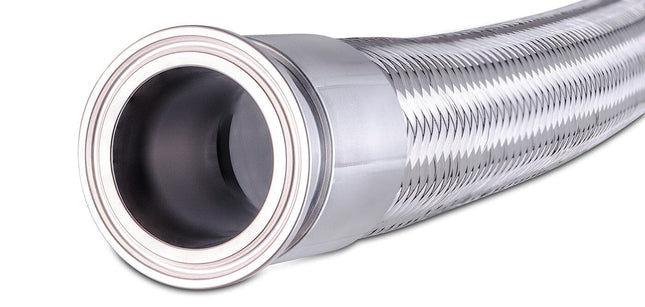

1.5" Tri-Clamp Stainless Steel Braided Hose with Convoluted PTFE Liner
1.5" Tri-Clamp Stainless Steel Braided Hose with Convoluted PTFE Liner This premium industrial hose assembly delivers superior performance in chemical processing and high-pressure fluid transfer applications. The convoluted PTFE liner provides exceptional chemical compatibility and flexibility, while the 304 stainless steel braid ensures structural strength and durability. Tri-Clamp end connections enable quick, reliable system integration. Performance Specifications: Connection Type 1.5" Tri-Clamp Liner Material PTFE (Teflon) Braid & Flanges 304 Stainless Steel Temperature Range -65°F to 450°F Pressure Rating 580 PSI Chemical Resistance Excellent Bend Radius 13" (24" length) / 5.5" (48"-96" lengths) Critical Operating Guidelines: Maintain bend radius specifications to prevent PTFE liner kinking and loss of hose integrity. The 24" version accommodates 90-degree bends only.
$250.00 - $500.00
-


Glacial Acetic Acid 99.8% Food Grade
Food Grade Glacial Acetic Acid 99.8% pH: 2.4 Looking for a food-grade acid for your acid-base extraction? Our premium Glacial Acetic Acid is precisely what you need! As a leading supplier of high-purity solvents & chemicals, we provide the purest Glacial Acetic Acid available for your acid-base extraction and pH adjustment needs, ensuring exceptional results every time. Acetic acid, also known as ethanoic acid, is a versatile organic compound that plays a significant role in various industries and everyday life. It is a colorless liquid with a pungent, vinegar-like odor. Acetic acid (CH3COOH) is a weak acid that is highly soluble in water and many organic solvents. Due to its unique properties, acetic acid is widely used as a solvent, preservative, and flavoring agent in the food and beverage industry. It is also a key component in the production of vinyl acetate, which is used in the manufacturing of adhesives, coatings, and textiles. Furthermore, acetic acid is utilized in the synthesis of numerous chemicals, including pharmaceuticals, dyes, and plastics. Its diverse range of applications makes acetic acid an essential compound in many industrial processes, where it contributes to the creation of countless products that we encounter in our daily lives. Glacial Acetic Acid, also known as ethanoic acid, is a highly concentrated and pure form of acetic acid. Its name, "glacial," refers to its ability to freeze at a relatively low temperature (16.6C/61.9F). This characteristic sets it apart from other forms of acetic acid, making it ideal for various industrial applications, including acid-base extraction. Our Glacial Acetic Acid contains less than 1% water and is also considered water-free anhydrous acetic acid. In acid-base extraction, Glacial Acetic Acid serves as an essential component due to its unique properties. It acts as a weak acid, enabling the extraction of alkaline compounds from organic mixtures. With our premium Glacial Acetic Acid, you can achieve efficient separation of target compounds by adjusting the pH and facilitating the formation of soluble salts. In addition to its use in acid-base extraction, our Glacial Acetic Acid finds widespread application in various industries, including pharmaceuticals, textiles, and food processing. It is also known for its ability to dissolve and remove mineral deposits, making it an excellent choice for descaling and cleaning applications. At BVV, we take pride in delivering premium solvents, chemicals, and adsorbents that exceed customer expectations. Our team of experts is always available to provide personalized support and guidance, ensuring that you find the right solution for your needs. With our high-purity Glacial Acetic Acid & Sodium Hydroxide, you can optimize your acid-base extraction processes and pH adjustment needs to achieve exceptional results. Ready to elevate your acid-base extraction procedures? Order our High Purity Glacial Acetic Acid & Sodium Hydroxide today and experience its superior quality and performance firsthand. Contact us now to learn more and take advantage of our competitive prices and prompt delivery. Unlock the potential of your acid-base extractions with BVV! Chemical Formula: CH3COOH Molecular Weight: 60.052 g·mol−1 CAS Registry Number: 64-19-7 Appearance Colorless, transparent liquid, Odor: Heavily vinegar-like Density 1.049 g/cm3 (liquid); 1.27 g/cm3 (solid) Boiling Point: 16 °C / 61°F GHS Pictograms: GHS Signal Word: Danger GHS Hazard Statements: H226, H314 GHS Precautionary Statements P280, P305+P351+P338, P310 UN Identification Number: 2789 Proper Shipping Name: Acetic Acid, Glacial Transport Hazard Class: 8 Packing Group: II DOT Placard: What is Acetic Acid? Acetic acid, also known as ethanoic acid, is a colorless liquid organic compound with a distinct sour taste and pungent smell. It is a member of the carboxylic acid family and is classified as a weak acid due to its partial ionization in aqueous solutions. Acetic acid is a fundamental building block in various chemical reactions and is commonly found in vinegar, giving it its characteristic sour taste. Chemically represented as CH3COOH, acetic acid consists of two main components: a carboxyl group (-COOH) and a methyl group (-CH3). It is produced naturally through fermentation processes, where bacteria convert ethanol into acetic acid. Additionally, acetic acid can be synthesized through various chemical methods for industrial applications. Acetic acid is widely utilized in various industries, including food, pharmaceuticals, textiles, and chemicals. It serves as a crucial ingredient in the production of plastics, solvents, dyes, and synthetic fibers. Its versatile nature makes it an essential component in countless products and processes, contributing to a wide range of applications across different sectors. What Is Acetic Acids Formula? Chemically represented as CH3COOH, acetic acid consists of two main components: a carboxyl group (-COOH) and a methyl group (-CH3). It is produced naturally through fermentation processes, where bacteria convert ethanol into acetic acid. Additionally, acetic acid can be synthesized through various chemical methods for industrial applications. What is Acetic Acids Structure? The structure of acetic acid consists of two carbon atoms (C), four hydrogen atoms (H), and two oxygen atoms (O) arranged in a specific pattern. It forms a molecule with a central carbon atom bonded to two oxygen atoms: one oxygen atom is double-bonded to the carbon (C=O) and the other is bonded via a single bond (C-OH). This arrangement creates a carboxyl group (COOH) at one end of the molecule. The remaining carbon and hydrogen atoms are bonded in a linear chain, resulting in the overall molecular structure of CH3COOH. What Is Acetic Acids Molar Mass? The molar mass of a chemical compound is a measure of the mass of one mole of that substance, expressed in grams per mole (g/mol). For acetic acid (CH3COOH), which is a simple organic compound, the molar mass is calculated by adding up the atomic masses of all the individual atoms in its chemical formula. Let's break down the components of acetic acid: Carbon (C) - Atomic mass: 12.01 g/mol Hydrogen (H) - Atomic mass: 1.01 g/mol (there are 2 hydrogen atoms) Oxygen (O) - Atomic mass: 16.00 g/mol (there are 2 oxygen atoms) Another Oxygen (O) - Atomic mass: 16.00 g/mol Hydrogen (H) - Atomic mass: 1.01 g/mol (there is 1 hydrogen atom) Now, add up the atomic masses: 12.01 g/mol (C) + 1.01 g/mol (H) + 1.01 g/mol (H) + 16.00 g/mol (O) + 16.00 g/mol (O) + 1.01 g/mol (H) = 60.05 g/mol Therefore, the molar mass of acetic acid is approximately 60.05 g/mol. This value is crucial for various chemical calculations and reactions involving acetic acid, including determining quantities in chemical reactions or preparing solutions with specific concentrations. What is the PKA of Acetic Acid? The pKa of acetic acid (CH3COOH) is approximately 4.75. The pKa value represents the acidity of a compound and indicates the strength of its dissociation in aqueous solution. Acetic acid is a weak acid, meaning that it does not completely dissociate into ions in water and has a relatively low tendency to donate protons (H+ ions). Is Acetic Acid A Weak or Strong Acid? Acetic acid (CH3COOH) is considered a weak acid. Weak acids are substances that only partially dissociate into ions when dissolved in water. In the case of acetic acid, it releases a limited number of hydrogen ions (H+) and acetate ions (CH3COO-) in water. This is in contrast to strong acids, which completely dissociate into ions and release a higher concentration of hydrogen ions in solution. What Is The Boiling Point of Acetic Acid? The boiling point of acetic acid is approximately 118.1 degrees Celsius (244.5 degrees Fahrenheit) at standard atmospheric pressure. However, this value can vary slightly depending on factors such as atmospheric pressure and impurities present in the acetic acid. What Is The Density of Acetic Acid? The density of acetic acid is approximately 1.049 grams per cubic centimeter (g/cm³) at 20 degrees Celsius (68 degrees Fahrenheit). Keep in mind that the density of acetic acid can vary slightly with temperature and concentration. What Is Glacial Acetic Acid? Glacial acetic acid, also known as anhydrous acetic acid, is a highly concentrated and pure form of acetic acid. The term "glacial" is used to describe its appearance, as it solidifies into ice-like crystals at room temperature due to its high freezing point. Glacial acetic acid typically has a concentration of around 99-100%, making it one of the purest forms of acetic acid available. This highly concentrated form of acetic acid is commonly used in various industrial, laboratory, and chemical applications. It is often utilized as a solvent, reagent, or catalyst in chemical reactions, as well as in the production of various chemicals, plastics, textiles, and pharmaceuticals. Glacial acetic acid's high purity and reactivity make it a valuable component in many manufacturing processes and scientific experiments. It's important to handle glacial acetic acid with care due to its corrosive and strong acidic properties. Proper safety precautions should be taken when working with this substance, including using appropriate protective equipment and following recommended handling procedures. What Is Acetic Acid Used For? Acetic acid is a versatile chemical compound with a wide range of applications across various industries. Here are some common uses of acetic acid: Food and Beverage Industry: Acetic acid is a key component in the production of vinegar, which is used as a condiment, flavor enhancer, and food preservative. It is also used in the production of pickles, sauces, and dressings. Chemical Industry: Acetic acid is used as a chemical intermediate in the production of various chemicals, including acetate esters, acetic anhydride, and vinyl acetate monomer. These chemicals are used in the manufacturing of plastics, synthetic fibers, dyes, and pharmaceuticals. Cleaning and Disinfecting: Acetic acid is commonly used as an environmentally friendly cleaning agent due to its mild acidity and disinfectant properties. It can effectively remove mineral deposits, stains, and mold from surfaces. Textile Industry: Acetic acid is used in the production of acetate fibers, which are used to make fabrics, textiles, and clothing items. It is also employed in dyeing and finishing processes. Photography: Acetic acid is used in photographic processes, including film development and as a fixing agent for prints. Preservation: Acetic acid is used to preserve and prevent spoilage in various agricultural products, such as fruits and vegetables. Laboratory and Research: Acetic acid is commonly used in laboratories for various purposes, including chemical analysis, pH adjustment, and buffer preparation. Medicine and Pharmaceuticals: Acetic acid is used in the synthesis of pharmaceutical compounds and as a solvent for certain medications and ointments. Wastewater Treatment: Acetic acid is used in wastewater treatment processes to adjust pH levels and promote the growth of beneficial microorganisms. Tanning Industry: Acetic acid is used in leather tanning processes to adjust the pH of the solutions and aid in the removal of unwanted substances. Plastics and Polymers: Acetic acid is a precursor in the production of polyvinyl acetate (PVA) and other polymer materials used in adhesives, coatings, and paints. Oil and Gas Industry: Acetic acid is employed in the oil and gas industry for processes such as well drilling, acidizing, and corrosion inhibition. Electronics Industry: Acetic acid is used for cleaning and etching electronic components and printed circuit boards. These are just a few examples of the diverse applications of acetic acid. Its chemical properties make it a valuable ingredient in numerous industrial and consumer products, contributing to various processes and sectors. What Are The Hazards of Acetic Acid? Acetic acid is generally considered safe when used properly and handled with care. However, like any chemical compound, it can pose certain hazards if not used and managed correctly. Here are some potential hazards associated with acetic acid: Corrosive Nature: Acetic acid is a corrosive substance, and concentrated solutions can cause severe irritation or burns to the skin, eyes, and respiratory tract upon direct contact. Prolonged exposure to the skin or eyes can result in chemical burns and tissue damage. Inhalation Risks: Inhaling acetic acid vapors or mists can irritate the respiratory system, causing symptoms such as coughing, shortness of breath, and throat irritation. Prolonged or intense exposure to vapors can lead to more severe respiratory effects. Fire and Explosion Hazard: Acetic acid is flammable, with a low flashpoint. Concentrated vapors or mists can ignite and potentially cause fires or explosions when exposed to an open flame, spark, or heat source. Incompatibility: Acetic acid may react with certain chemicals and substances, resulting in potentially hazardous reactions or releases of toxic gases. Proper storage and handling procedures are essential to prevent such interactions. Toxicity: Ingesting or consuming concentrated acetic acid can lead to serious health issues, including chemical burns in the digestive tract, internal injuries, and other toxic effects. Ingestion should be avoided. Environmental Impact: Improper disposal or release of acetic acid into the environment can harm aquatic life and ecosystems. It can also contribute to air pollution when released into the atmosphere. Sensitization: Prolonged or repeated exposure to acetic acid can lead to sensitization, where an individual becomes more susceptible to adverse effects upon subsequent exposures. To mitigate these hazards and ensure safe handling of acetic acid, it's important to follow proper safety guidelines and precautions How Do I Use Glacial Acetic Acid Safely? Using glacial acetic acid safely is essential due to its corrosive and strong acidic properties. Follow these guidelines to ensure safe handling and use: Personal Protective Equipment (PPE): Wear appropriate PPE, including chemical-resistant gloves, safety goggles, a lab coat or protective clothing, and closed-toe shoes to prevent contact with the skin, eyes, and clothing. Well-Ventilated Area: Work in a well-ventilated area or use a fume hood to minimize inhalation exposure. Ensure proper ventilation to prevent the buildup of fumes. Avoid Contact: Avoid direct skin contact with glacial acetic acid. In case of accidental skin contact, immediately rinse the affected area with copious amounts of water and seek medical attention if irritation persists. Eye Protection: Wear safety goggles or a face shield to protect your eyes from potential splashes or fumes. In case of eye contact, rinse the eyes thoroughly with water and seek immediate medical assistance. Handling and Pouring: When handling glacial acetic acid, use chemical-resistant containers and utensils. Pour slowly to avoid splashing and minimize the release of fumes. Always use a chemical-resistant funnel for transferring the acid. Dilution: If dilution is required, always add glacial acetic acid to water, never the other way around. Adding water to the acid can cause a violent reaction. Storage: Store glacial acetic acid in a cool, dry, and well-ventilated area, away from direct sunlight and incompatible substances. Ensure proper labeling of containers and keep them tightly sealed to prevent evaporation and fume release. First Aid: Have an eyewash station and safety shower readily accessible in case of accidental exposure. Know the location of emergency exits and procedures. Emergency Response: In case of spills or leaks, contain and absorb the acid using appropriate absorbent materials. Neutralize any spilled acid with a suitable neutralizing agent under proper ventilation. Dispose of contaminated materials as hazardous waste. Training: Ensure that personnel handling glacial acetic acid are trained in its proper handling, storage, and emergency response procedures. Regularly review safety protocols. Medical Attention: If you experience skin contact, eye exposure, or inhalation of fumes, seek medical attention immediately. Provide medical professionals with accurate information about the substance involved. Always refer to the Material Safety Data Sheet (MSDS) or Safety Data Sheet (SDS) provided by the manufacturer for specific safety information and handling guidelines for the glacial acetic acid product you are using. Following proper safety protocols and practices is crucial to prevent accidents and ensure the well-being of individuals working with glacial acetic acid. Acetic Acid Glacial 99.8% Certificate of Analysis (COA) Acetic Acid Glacial 99.8% Safety Data Sheet (SDS)
$14.00 - $3,800.00
-
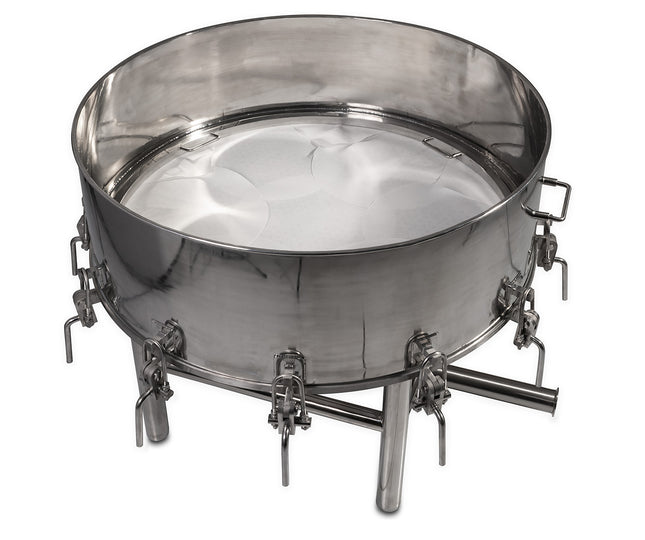

36 inch Filtration Funnel V2
Buchner Filtration Kit This filtration kit is operated by using a vacuum pump to pull the solution through the filter paper to remove particulate. The funnel has a 36" perforated plate to support the filter paper.
$7,600.00 - $8,180.00
-
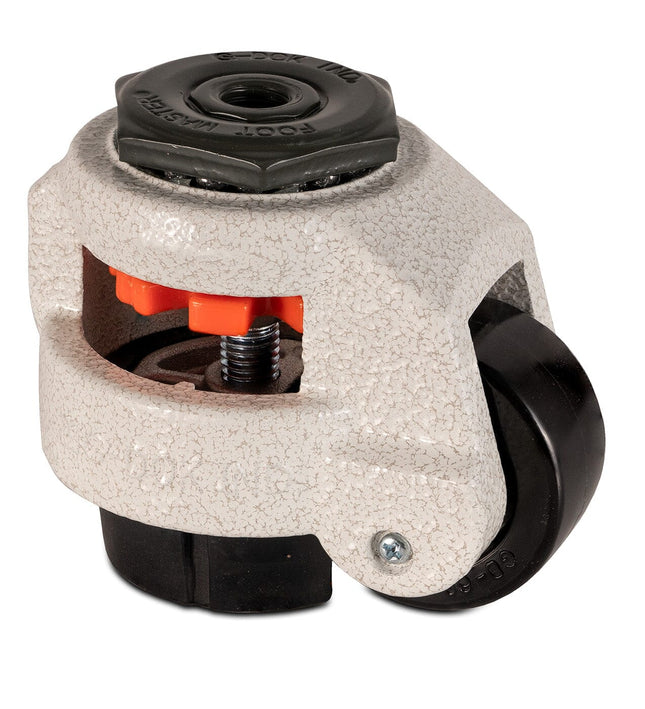

2" Footmaster Leveling Caster Ivory - 550lb cap
2" Footmaster Leveling Caster Ivory This ingenious product combines the mobility of a caster, the height adjustability of a level mount, and the stability of a foot pad. The GD Series leveling caster profile is integral to its function. A thick aluminum frame is used to achieve the combination of being both strong and compact. The swivel section contains 2 sets of ball bearings for easy maneuverability. Bearing raceway sleeves made from hardened steel prevent scouring to the aluminum frame, leading to high performance and dependable reliability. Moving is easy thanks to a 50 mm diameter wheel mated with an axle shaft made of cold forged steel. And once positioned, the caster provides side access to an ABS thermoplastic thumbwheel used to lower the foot pad. As the wheel is lifted off the ground, the foot pad takes over to make the application completely stationary. Making the fine adjustments to achieve the perfect level set, even under heavy loads, is light work for this world renowned leveling caster. When it is time to move again, simply raise the foot pad to restore the freedom of mobility.
$125.00
-
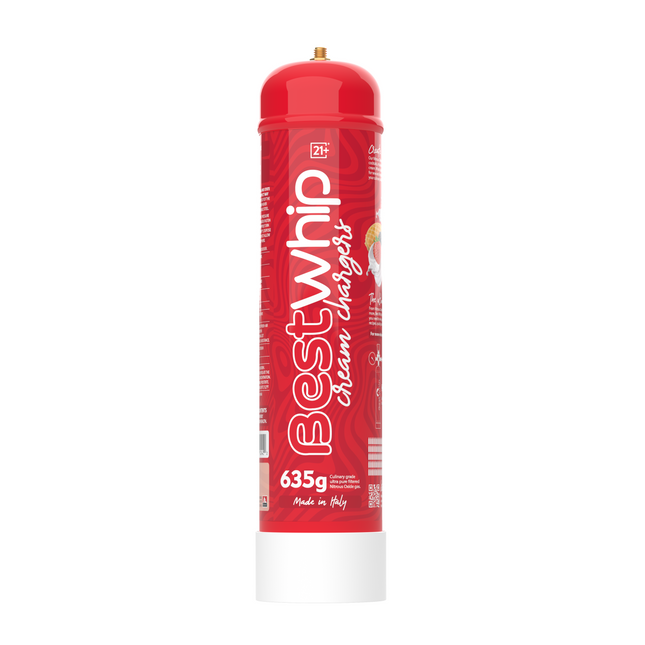

Best Whip Best Whip Food-Grade Nitrous Oxide Tank 99% Pure (635g / 321 liters)
Best Whip Nitrous Oxide 635g Liquid / 1.4lbs liquid / 321 Gas Volume Liters 99% Purity / Liquid N2O This innovative cylinder is the fastest and easiest way to replenish your cream. It is not only a good assistant for making dessert at home but also a new solution for the industrial catering industry! Before using our whipped cream-making equipment you must first read the manufacturer's instructions. This will show you how to safely charge your cream using the cream 635g tank. Cylinder Fitting: M11x1 Thread (compatible with the Best Whip Nitrous Oxide Regulator.) Tank Pressure: 755 PSI Includes 1 nozzle per tank. *At end of use use this nozzle to completely empty the tank for recycling. SUPER GAS QUALITY - Each tank is filled high quality NO2. That is why you will not have a hard time making chocolate or vanilla, mint, or Bailey's flavored cream whipper. Cocktail foams, airy sauce, mousse, and hot or cold foam can be made easily, too. FOOD-GRADE & LONG SHELF LIFE - Best Whip tanks are made with food-grade compliance and production standards. Each tank has a long shelf life of 5 years so you can use them over a period of time. ANTI-LEAKAGE DESIGN - Best Whip canister conforms with Manufacturing International Standards such as ISO 9001, and ISO 9002. Any cream dispenser can be used with this cylinder. UNIVERSAL COMPATIBILITY - Compatible with all professional whipped cream makers in the market. From now on, you can easily finish making whipped cream in a few seconds and without leaving odors or contaminants in the dispenser. RECYCLEABLE CONTAINER - Made of steel construction. When you're done with it simply attach the included nozzle to discharge any remaining gas and place it in the recycling bin. What Is Nitrous Oxide? Nitrous Oxide is a chemical compound with the formula N2O. It is a colorless, non-flammable gas with a slightly sweet odor and taste. Nitrous oxide is often used for various purposes due to its unique properties and effects. What is Nitrous Oxide Used For? Nitrous oxide (N2O) is most commonly used in the culinary world for various purposes, primarily for creating foams, whipped creams, and infusions. Outside the culinary world nitrous oxide is also commonly utilized as a propellant, a cryogenic refrigerant, and as a performance-enhancing additive for internal combustion engines. Here's how nitrous oxide is most commonly used in culinary applications: Whipped Cream: Nitrous oxide is perhaps most well-known in the culinary field for its use in making whipped cream. In this application, heavy cream and sweeteners are combined in a whipped cream dispenser or siphon, and nitrous oxide cartridges are used to pressurize the dispenser. When the cream is released from the dispenser, the sudden release of pressure causes the nitrous oxide to expand and whip the cream into a light and fluffy texture. This method allows for the creation of stable whipped cream that retains its texture for an extended period. Foams: Chefs use nitrous oxide to create foams from various liquids, such as fruit juices, sauces, and purees. To make a foam, the desired liquid is mixed with a gelling agent, strained, and loaded into a whipped cream dispenser along with nitrous oxide. When dispensed, the nitrous oxide aerates the liquid, resulting in a light and airy foam that can be used as a garnish or flavor enhancer. Infusions: Nitrous oxide can be used to infuse liquids with the flavors of herbs, spices, fruits, or other aromatic ingredients. For example, herbs like basil or spices like cinnamon can be placed in a whipped cream dispenser along with a liquid (e.g., oil or alcohol) and nitrous oxide. The pressurized nitrous oxide infuses the liquid with the flavors and aromas of the added ingredients quickly. Cocktails: Some bartenders use nitrous oxide to create foam or froth on cocktails, adding a unique visual and textural element to drinks. This technique is especially popular in molecular mixology. Sauces and Dressings: Nitrous oxide can be used to create light and airy sauces or dressings. By adding nitrous oxide to a mixture of liquids and ingredients, chefs can achieve a desired texture and consistency. Desserts: Nitrous oxide can be used to create innovative desserts, such as foamy fruit purees, mousse-like textures, and light, airy soufflés. It's essential to use food-grade nitrous oxide and follow proper safety precautions when using it in culinary applications. The use of nitrous oxide cartridges and whipped cream dispensers is common in professional kitchens and home cooking to achieve these culinary effects. What Are The Hazards Of Nitrous Oxide? Nitrous oxide (N2O), while commonly used in various applications can pose certain hazards if not used properly. Here are some potential hazards associated with nitrous oxide: Asphyxiation: The most significant hazard of nitrous oxide in culinary use is the risk of asphyxiation. Nitrous oxide can displace oxygen in an enclosed space, leading to oxygen deprivation if inhaled in high concentrations. This can result in dizziness, loss of consciousness, and even death. Frostbite: Nitrous oxide is stored as a compressed liquid and is extremely cold when released. Contact with liquid nitrous oxide can cause frostbite or cold burns to the skin. Care should be taken when handling nitrous oxide cartridges or dispensers. Is Nitrous Oxide Flammable? Nitrous oxide (N2O) is not flammable in the typical sense because it does not support combustion. However, it can contribute to the combustion of other substances. Here's a more detailed explanation: Non-Flammable: Nitrous oxide itself does not burn or catch fire. It is an oxidizer, meaning it can support the combustion of other substances by providing oxygen. When nitrous oxide is used in applications like rocket propulsion or automotive nitrous systems, it does not ignite by itself. Enhancing Combustion: Nitrous oxide is sometimes used in combination with fuel in internal combustion engines to increase power output. In this context, it is often referred to as "nitrous" or "NOS." When nitrous oxide is injected into the engine's intake, it provides additional oxygen, allowing more fuel to burn, resulting in increased engine power. However, it's important to note that this process is controlled and safe when used as intended in automotive applications. Safety Precautions: While nitrous oxide is generally considered safe when used according to manufacturer guidelines, improper handling or misuse can be hazardous. Nitrous oxide should not be exposed to open flames, sparks, or high temperatures, as it can decompose at elevated temperatures and pressure, potentially leading to the release of oxygen and nitrogen gases. In summary, nitrous oxide is not flammable by itself, but it can enhance the combustion of other materials when used in controlled and purposeful applications. When using nitrous oxide, it's essential to follow safety guidelines and avoid exposing it to conditions that could lead to its decomposition or unintended ignition. How Do I Use Nitrous Oxide Safely? Using nitrous oxide (N2O) safely is crucial to prevent accidents and health risks. Here are some general guidelines for using nitrous oxide safely: Follow Manufacturer's Instructions: Always follow the manufacturer's instructions for any equipment or cartridges containing nitrous oxide. Different devices or cartridges may have specific usage guidelines. Ventilation: Ensure that you use nitrous oxide in a well-ventilated area. Adequate ventilation helps disperse any gas leaks and prevents the buildup of nitrous oxide in confined spaces, reducing the risk of asphyxiation. Avoid Direct Inhalation: Never inhale nitrous oxide directly from cartridges, whipped cream dispensers, or any other source. Inhaling nitrous oxide for recreational purposes can be dangerous and is not recommended. Protective Gear: When handling nitrous oxide cartridges or equipment, especially if they contain liquid nitrous oxide, wear appropriate protective gear, such as gloves and safety glasses, to prevent frostbite or cold burns. Store Safely: Store nitrous oxide cartridges and equipment in a cool, dry place away from direct sunlight and heat sources. Keep them out of the reach of children and unauthorized individuals. No Smoking: Avoid smoking or open flames near nitrous oxide,while nitrous oxide is not flammable, it will support combustion to the same extent as oxygen. Training and Education: Ensure that individuals using nitrous oxide equipment are trained in its safe handling and usage. Leak Detection: Regularly check for leaks in nitrous oxide equipment and connections. Use a leak detection solution (soapy water) to identify leaks by observing bubbles at the connections. Proper Disposal: Dispose of used nitrous oxide cartridges and equipment according to local regulations and guidelines. Do not puncture or incinerate cartridges. Emergency Preparedness: Be prepared for emergencies by having safety equipment, such as fire extinguishers and first-aid kits, readily available in areas where nitrous oxide is used or stored. Follow Legal Regulations: Abide by local laws and regulations regarding the sale, purchase, and use of nitrous oxide. In some areas, nitrous oxide may be subject to restrictions due to its potential for misuse. Always exercise caution and prioritize safety when using nitrous oxide, whether it's for culinary, automotive, medical, or other legitimate purposes. If you have specific concerns or questions about the safe use of nitrous oxide in a particular context, consult with experts or regulatory authorities in your area. Chemical Formula: N2O Molecular Weight: 44.013 g/mol CAS Registry Number: 10024-97-2 Appearance Colorless Odor: Characteristic Density 0.115 lb/ft3 Boiling Point: -88.5C (-127.3F) Solubility in water: Completely Soluble GHS Pictograms: GHS Signal Word: Danger GHS Hazard Statements: H270, H280, H281, H336 GHS Precautionary Statements P220, P244, P261, P271, P282, P304+P340, P319, P336+P317, P370+P376, P403, P403+P233, P405, P410+P403, P501 UN Identification Number: 1070 Proper Shipping Name: Nitrous Oxide Transport Hazard Class: 2.2, 5.1 Packing Group: None DOT Placard: Nitrous Oxide Safety Data Sheet (SDS)
$48.00 - $190.00
-
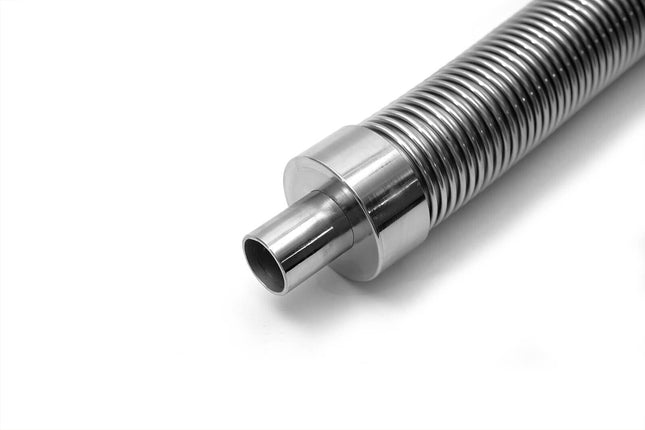

Insulon 1" Insulon Vacuum Jacketed Hose, Low Pressure
1" Insulon Vacuum Jacketed Hose, Low Pressure Technical Specifications: Hose Size 1” ID DN (ISO 10380) 25 Product Category LP (Low Pressure) Inner Hose ID 0.984” Tube Stub OD 1.000” Tube Stub Thickness 0.065” Outer Hose OD 1.95” Static Bend Radius 5.08” Dynamic Bend Radius 13.39” Lengths 2 – 20’ Operating Temperature -270°C to 900°C (-454°F to 1652°F) Material 316L stainless steel Maximum Allowable Working Pressure (MAWP) by Temperature: Product Category Hose Size Max Temperature (C) Max Temperature (F) MAWP (PSI) Low Pressure (LP) 1" ID 21 70 43 Low Pressure (LP) 1" ID 66 150 40 Low Pressure (LP) 1" ID 93 200 38 Low Pressure (LP) 1" ID 121 250 37 Low Pressure (LP) 1" ID 149 300 36 Low Pressure (LP) 1" ID 166 330 35 Low Pressure (LP) 1" ID 204 400 34 Low Pressure (LP) 1" ID 232 450 34 Low Pressure (LP) 1" ID 260 500 33 Low Pressure (LP) 1" ID 316 600 33 Low Pressure (LP) 1" ID 371 700 33 Low Pressure (LP) 1" ID 427 800 32 Low Pressure (LP) 1" ID 482 900 32 Low Pressure (LP) 1" ID 538 1000 31 Low Pressure (LP) 1" ID 593 1100 29 Low Pressure (LP) 1" ID 649 1200 26 Low Pressure (LP) 1" ID 704 1300 24 Low Pressure (LP) 1" ID 760 1400 21 Low Pressure (LP) 1" ID 816 1500 17 Low Pressure (LP) 1" ID 899 1650 11
$311.00 - $1,559.00
-
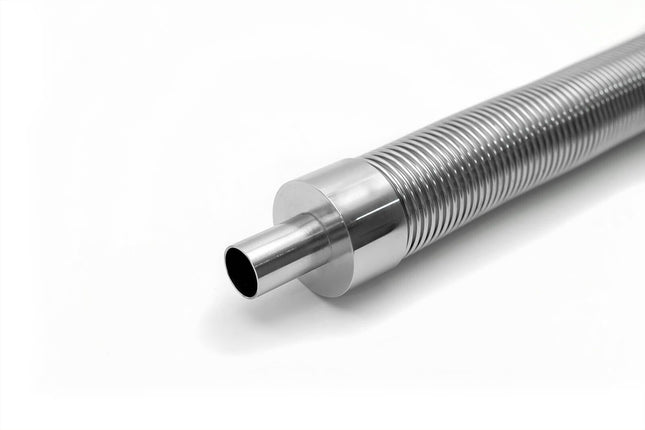

Insulon 3/4" Insulon Vacuum Jacketed Hose, Low Pressure
3/4" Insulon Vacuum Jacketed Hose, Low Pressure Technical Specifications: Hose Size 3/4” ID DN (ISO 10380) 20 Product Category LP (Low Pressure) Inner Hose ID 0.787” Tube Stub OD 0.750” Tube Stub Thickness 0.049” Outer Hose OD 1.62” Static Bend Radius 4.1” Dynamic Bend Radius 11.81” Lengths 2 – 20’ Operating Temperature -270°C to 900°C (-454°F to 1652°F) Material 316L stainless steel Maximum Allowable Working Pressure (MAWP) by Temperature: Product Category Hose Size Max Temperature (C) Max Temperature (F) MAWP (PSI) Low Pressure (LP) 3/4" ID 21 70 43 Low Pressure (LP) 3/4" ID 66 150 40 Low Pressure (LP) 3/4" ID 93 200 38 Low Pressure (LP) 3/4" ID 121 250 37 Low Pressure (LP) 3/4" ID 149 300 36 Low Pressure (LP) 3/4" ID 166 330 35 Low Pressure (LP) 3/4" ID 204 400 34 Low Pressure (LP) 3/4" ID 232 450 34 Low Pressure (LP) 3/4" ID 260 500 33 Low Pressure (LP) 3/4" ID 316 600 33 Low Pressure (LP) 3/4" ID 371 700 33 Low Pressure (LP) 3/4" ID 427 800 32 Low Pressure (LP) 3/4" ID 482 900 32 Low Pressure (LP) 3/4" ID 538 1000 31 Low Pressure (LP) 3/4" ID 593 1100 29 Low Pressure (LP) 3/4" ID 649 1200 26 Low Pressure (LP) 3/4" ID 704 1300 24 Low Pressure (LP) 3/4" ID 760 1400 21 Low Pressure (LP) 3/4" ID 816 1500 17 Low Pressure (LP) 3/4" ID 899 1650 11
$289.00 - $1,375.00
-
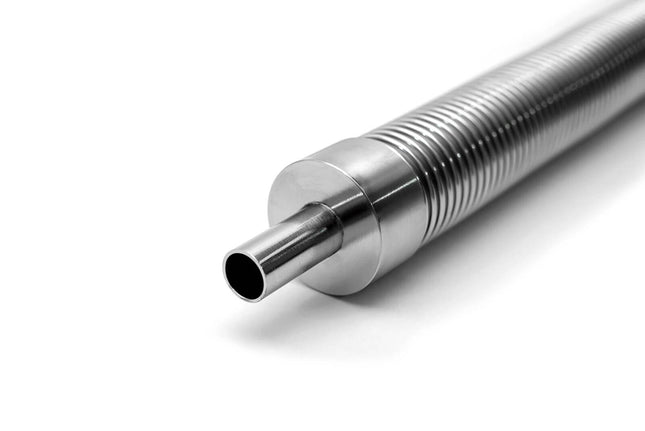

Insulon 1/2" Insulon Vacuum Jacketed Hose, Low Pressure
1/2" Insulon Vacuum Jacketed Hose, Low Pressure Technical Specifications: Hose Size 1/2” ID DN (ISO 10380) 12 Product Category LP (Low Pressure) Inner Hose ID 0.472” Tube Stub OD 0.500” Tube Stub Thickness 0.035” Outer Hose OD 1.27” Static Bend Radius 3.33” Dynamic Bend Radius 10.24” Lengths 2 – 20’ Operating Temperature -270°C to 900°C (-454°F to 1652°F) Material 316L stainless steel Maximum Allowable Working Pressure (MAWP) by Temperature: Product Category Hose Size Max Temperature (C) Max Temperature (F) MAWP (PSI) Low Pressure (LP) 1/2" ID 21 70 72 Low Pressure (LP) 1/2" ID 66 150 67 Low Pressure (LP) 1/2" ID 93 200 64 Low Pressure (LP) 1/2" ID 121 250 62 Low Pressure (LP) 1/2" ID 149 300 60 Low Pressure (LP) 1/2" ID 166 330 58 Low Pressure (LP) 1/2" ID 204 400 56 Low Pressure (LP) 1/2" ID 232 450 56 Low Pressure (LP) 1/2" ID 260 500 55 Low Pressure (LP) 1/2" ID 316 600 55 Low Pressure (LP) 1/2" ID 371 700 55 Low Pressure (LP) 1/2" ID 427 800 54 Low Pressure (LP) 1/2" ID 482 900 53 Low Pressure (LP) 1/2" ID 538 1000 53 Low Pressure (LP) 1/2" ID 593 1100 48 Low Pressure (LP) 1/2" ID 649 1200 44 Low Pressure (LP) 1/2" ID 704 1300 40 Low Pressure (LP) 1/2" ID 760 1400 35 Low Pressure (LP) 1/2" ID 816 1500 28 Low Pressure (LP) 1/2" ID 899 1650 18
$260.00 - $1,172.00
-

Insulon 1/4" Insulon Vacuum Jacketed Hose, Low Pressure
1/4" Insulon Vacuum Jacketed Hose, Low Pressure Due to vendor policies, any of these Insulon Vacuum Jacketed Hoses are final sale, non-returnable, and non-refundable. Technical Specifications: Hose Size 1/4" ID DN (ISO 10380) 6 Product Category LP (Low Pressure) Inner Hose ID 0.236” Tube Stub OD 0.250” Tube Stub Thickness 0.035” Outer Hose OD 1.05” Static Bend Radius 2.65” Dynamic Bend Radius 8.86” Lengths 2 – 20’ Operating Temperature -270°C to 900°C (-454°F to 1652°F) Material 316L stainless steel Maximum Allowable Working Pressure (MAWP) by Temperature: Product Category Hose Size Max Temperature (C) Max Temperature (F) MAWP (PSI) Low Pressure (LP) 1/4" ID 21 70 72 Low Pressure (LP) 1/4" ID 66 150 67 Low Pressure (LP) 1/4" ID 93 200 64 Low Pressure (LP) 1/4" ID 121 250 62 Low Pressure (LP) 1/4" ID 149 300 60 Low Pressure (LP) 1/4" ID 166 330 58 Low Pressure (LP) 1/4" ID 204 400 56 Low Pressure (LP) 1/4" ID 232 450 56 Low Pressure (LP) 1/4" ID 260 500 55 Low Pressure (LP) 1/4" ID 316 600 55 Low Pressure (LP) 1/4" ID 371 700 55 Low Pressure (LP) 1/4" ID 427 800 54 Low Pressure (LP) 1/4" ID 482 900 53 Low Pressure (LP) 1/4" ID 538 1000 53 Low Pressure (LP) 1/4" ID 593 1100 48 Low Pressure (LP) 1/4" ID 649 1200 44 Low Pressure (LP) 1/4" ID 704 1300 40 Low Pressure (LP) 1/4" ID 760 1400 35 Low Pressure (LP) 1/4" ID 816 1500 28 Low Pressure (LP) 1/4" ID 899 1650 18
$240.00 - $1,008.00
-

Brass Bulk Head Short
Brass Bulk Head Short This bulkhead is made to seal through a vacuum chamber wall up to 1/2" thick. The threads on the stem are 5/16" - 18, and on the outside of the chamber there will be 1/4" NPT threads to connect a variety of fittings.
$6.00
-

6" Jacketed Hemispherical Reducer Compression
6" Jacketed Hemispherical Reducer Compression This hemispherical reducer will go from a 6" tri clamp to a 1/2" Compression fitting. The compression fitting is the preferred choice for sanitary connections to eliminate possible contamination from particles getting stuck within threads. The jacket around the outside of the reducer has 2x 1/2" NPT ports to connect to a temperature controlled circulator.
$315.00
-

Stainless Tri-Clamp Weldless Bulkhead
Stainless Tri-Clamp Weldless Bulkhead This tri clamp bulkhead or panel mount can be mounted through a vessel wall such as vacuum chamber or tank. It has a silicone or buna-n tri clamp gasket that is placed on the outside of the chamber or vessel. It is capable of holding vacuum, and can also withstand positive pressure 8-10 psi is expected but depending on the installation geometries and material you can expect some higher pressures than that. It will be able to hold vacuum, but not high positive pressure. For best vacuum results, vacuum greases is recommended on the sealing surface of the panel/lid or vessel wall. Max wall thickness: .875" Hole Size: TCPM150- 1.3-1.4" TCPM200- 1.9-2.0" Thread Size: TCPM150- 1" NPS TCPM200- 1.5" NPS
$45.00 - $55.00
-
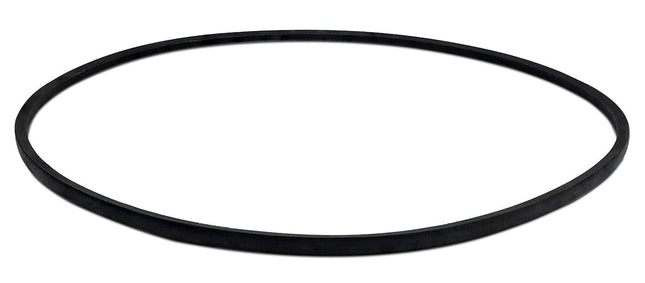

Centrifuge Belt
Centrifuge Belt Replacement Belt for the 160L & 45L Centrifuge. *Each centrifuge may have multiple belts
$130.00 - $195.00
-
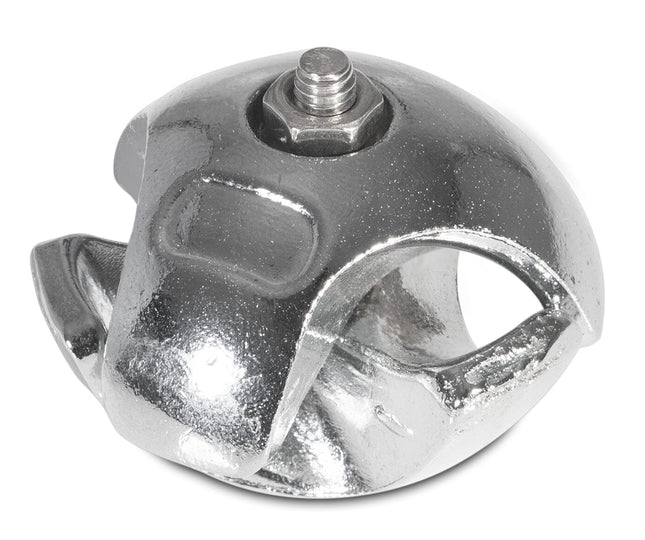

Lattice Clamp
Lattice Clamp This clamp will connect two lab stands/ rods perpendicular to each other to create a lattice structure to have many more mounting points on your laboratory glass.
$6.00
-
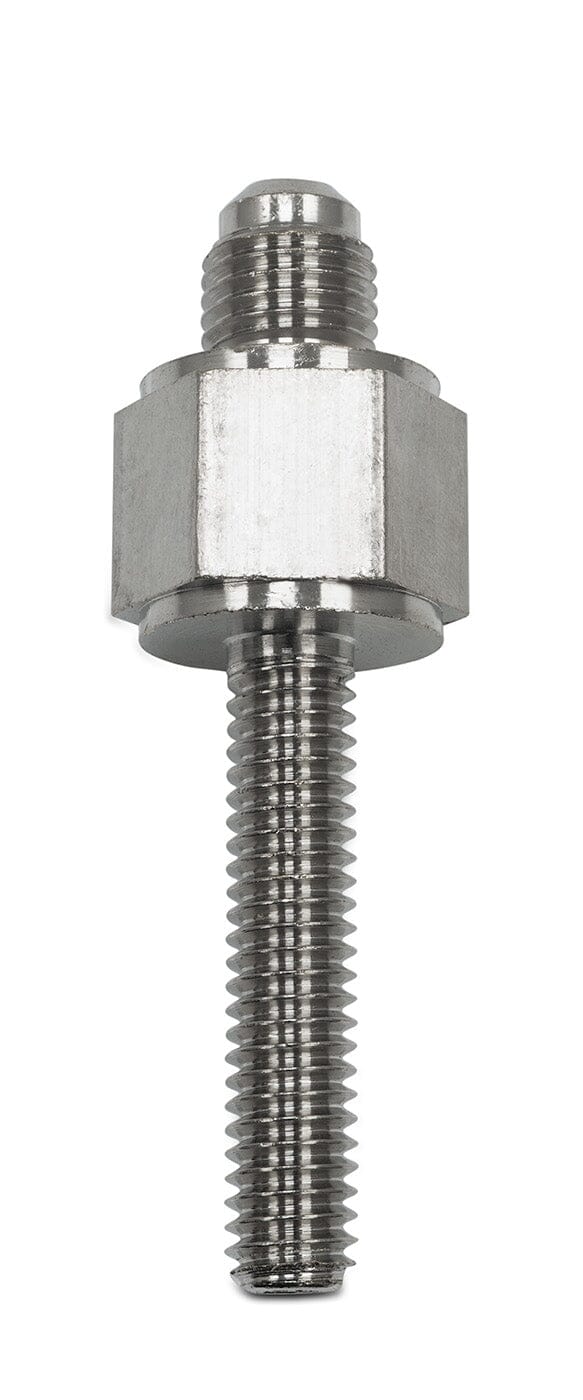
Bulk Head Long with Flare
Long Bulk Head with Flare This Long Bulk Head with Flare comes equipped with an extended 1/5" long thread with 1/4" MJIC flare perfect for applications with larger wall thicknesses. The optimal hole diameter for installing this bulkhead would be 5/16"
$8.00
-
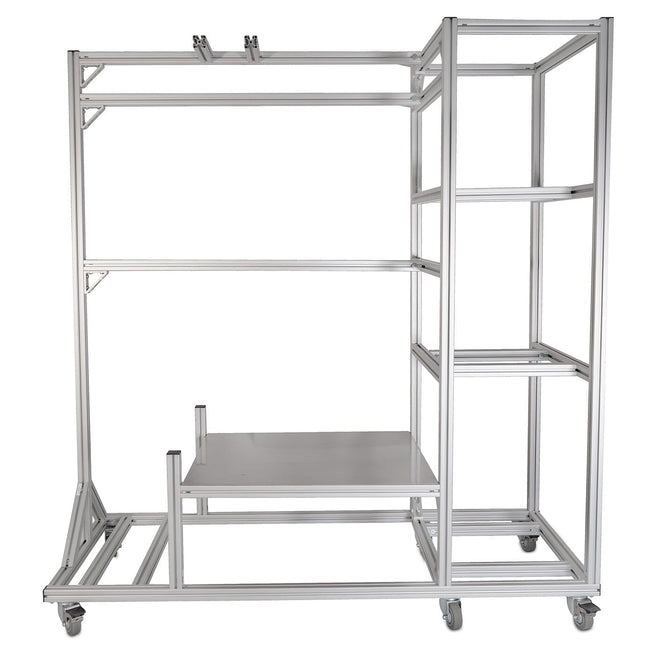

WFE Rack 8
Extruded Aluminum Framing Rack This rack is constructed of 1.5" extruded aluminum framing. This framing has slots that can be used for a wide variety of mounting hardware. This large rack is a good size to contain a wiped film or similar distillation equipment, along with three laboratory heaters/chillers stacked on the right side. The rack has six swivel casters for smooth transport with locking wheels in the corners. NOTE: This rack ships unassembled. Allow 6 hours for assembly
$3,900.00
-
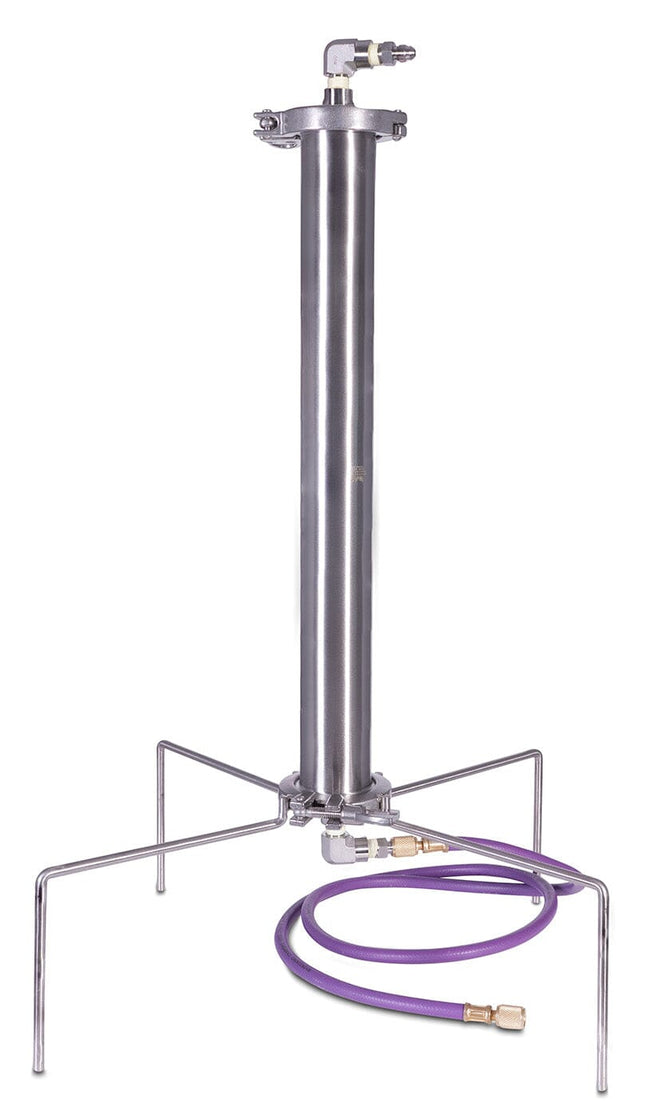

Inline Candy Desiccant Dryer
The inline candy desiccant dryer is a necessary accessory to any one using a vacuum oven for candy drying. The column will need to be filled by the user with silica gel and has fine mesh stainless filters on each end to hold in the beads. We recommend connecting the vacuum inlet from the pump to the top of the column to prevent any water accumulation in the beads from reaching the pump via gravity. The bottom of the column will connect to the oven itself. The column holds 1.5lb of silica gel desiccant. Its water holding capacity is 36%. Since 1lb of candy can hold as much as 40-60g of water, a 1lb column of desiccant will have the capacity to handle approximately 4.5-5lb of fresh candy drying before it needs to be reactivated. Silica gel can be reactivated by placing in an oven on a sheet pan for 0.5-2.0 hours at 200-250F or microwave for 10 minutes on defrost. BVV Hook Up Guide - Quick Assembly PDF Size Variants Standard Size 2" Outside Diameter x 24" Tall Column (Holds 1.5lbs Silica) XL Size Column 3" Outside Diameter x 36" Tall Column (Hold 6.5lbs Silica) Extension Kit for the Standard Column 2" Outside Diameter x 24" Tall (Holds1.5lbs Silica) *Silica Gel: Source from amazon (USE Clear silica gel) https://www.amazon.com/Dry-Quart-White-Silica-Desiccant/dp/B014VM4AZI/ref=sr_1_3?crid=N1FARCPRUFPT&keywords=silica+gel+clear&qid=1678139406&sprefix=silica+gel+cle%2Caps%2C100&sr=8-3
$70.00 - $318.00
-
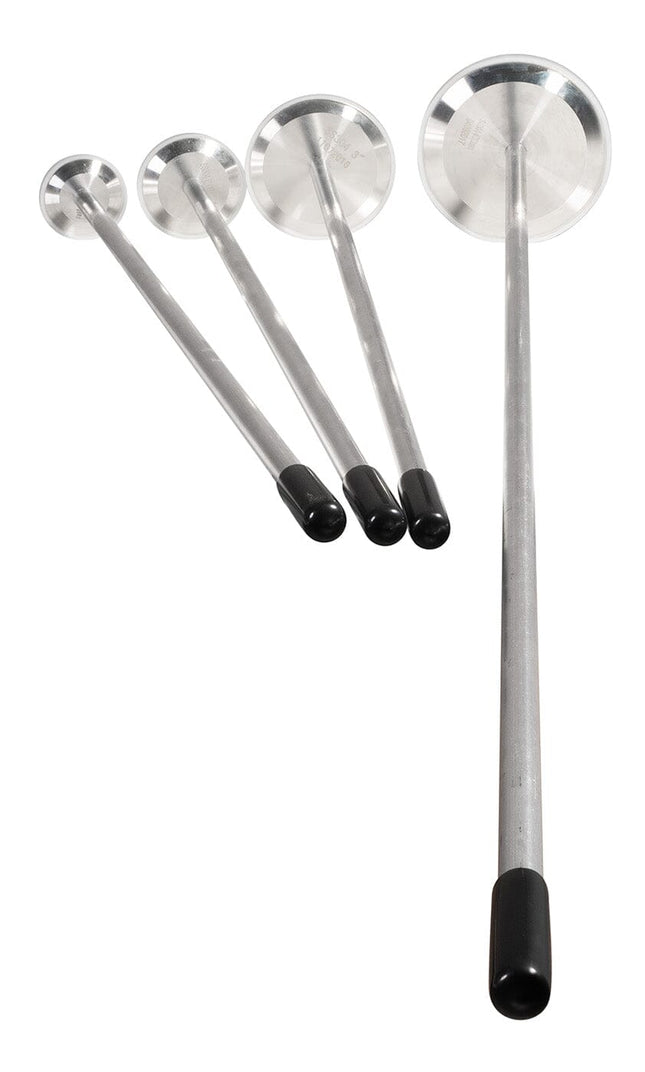

Extractor Material Packing Rod
Extractor Material Packing Rod This affordable and economic tool is throwback to the old days in the BVV lab. This is what we used then and we still use now. Never released for sale until now, we decided we think everyone will like them as much as we do. Simple and sturdy this tool will last as long as ours have; 7 years and more! Constructed of an aluminum shaft with a fixed stainless steel end plate, plastic guard, and stainless hardware. The packing rod is light weight and the added guard makes for a non-scratching design. The best feature is that it will fit the column with a small gap around the circumference and makes packing quick work. Available in 24" and 36" rods. They are not designed to be extendable so if you needed a longer size just send us an email to support@shopbvv.com and we can send you a price quote. For a full stainless steel professional grade packing rod check out this BVV item Stainless Steel Extractor Packing Rod SKU# PROD15024
$26.00 - $44.00
-
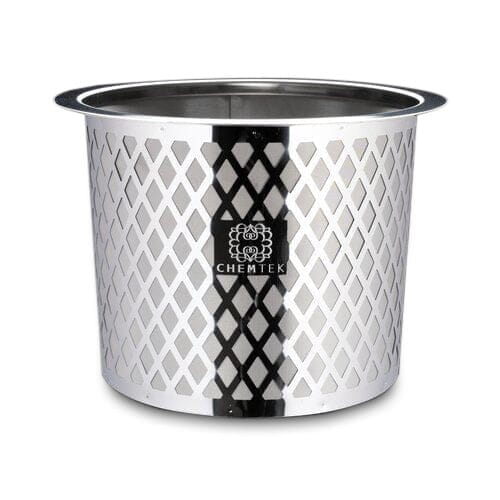
ChemTek ChemTek 6" Sweating Baskets
ChemTek 6" Sweating Baskets Sweat the terpene sauce off of your crystalized compounds or dry out sugars. Specifications: 25 Micron 304 Stainless Steel H: 4.5” W: 6”
$25.00 - $80.00
-
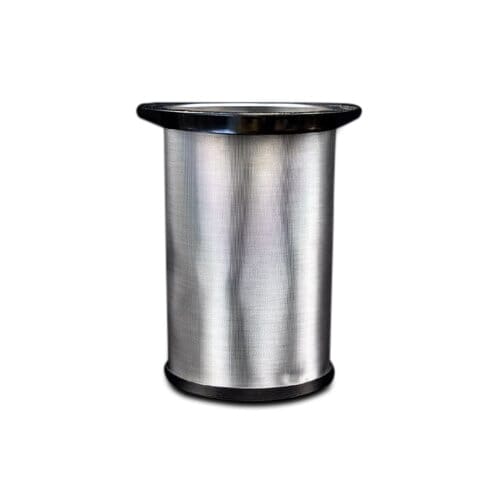
ChemTek 4" Sweating Baskets
4" Sweating Baskets Sweat the terpene sauce o of your crystallized compounds or dry out wet sugars using a tri-clamp spool. Specifications: 304 Stainless Steel 25 Micron W: 4” H: 5”
$17.00 - $55.00
-
ChemTek ChemTek 3" Sweating Baskets
ChemTek 3" Sweating Baskets Sweat the terpene sauce off of your crystalized compounds or dry out sugars. Specifications: 25 Micron 304 Stainless Steel H: 6” W: 3 1/4”
$15.00 - $50.00
-
ChemTek ChemTek Large Fuge Bags - 50 Pack
ChemTek Large Fuge Bags - 50 Pack Centrifuge bags used for separations. Specifications: Size: 50-Pack Dimensions: H: 7” W: 6.5” Micron Size: 25 Micron Material: Food Grade Nylon
$50.00
-

ChemTek ChemTek Medium Fuge Bags - 50 Pack
ChemTek Medium Fuge Bags - 50 Pack Centrifuge bags used for separations Specifications: Size: 50-Pack Dimensions:H: 7” W: 5” Micron Size: 25 Micron Material: Food Grade Nylon
$30.00


You have seen 576 out of 1796 products