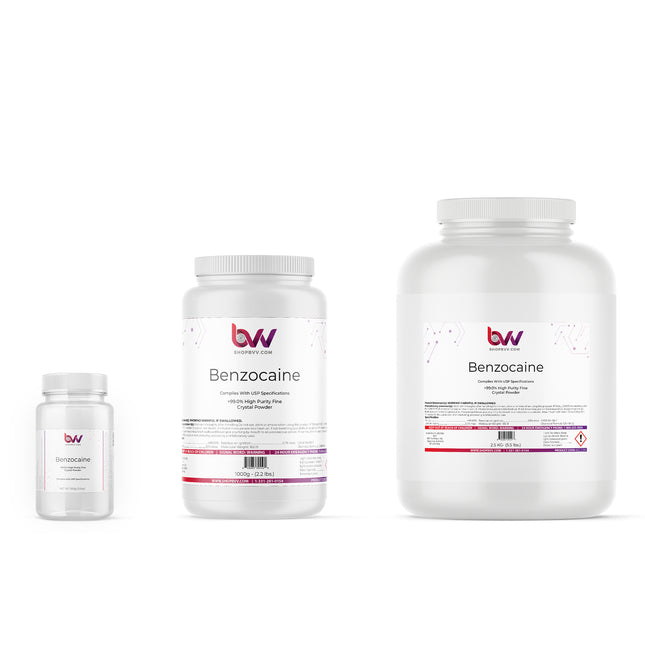
Lidocaine ≥99.0%
Complies with USP Testing Specifications
Lidocaine Hydrochloride is a professional grade, white crystalline powder intended exclusively for professional, nonclinical laboratory research, chemical analysis, and testing. This product is not marketed, labeled or intended for medical treatment, veterinary applications, pharmaceutical compounding, or administration to humans or animals. It is not intended for incorporation into cosmetics, food, beverages, or dietary supplements, or for personal or household use.
Specifications:
Assay: 97.5% – 102.5%
Melting Range: 66°C – 69°C
Water Content (H₂O): 5.0% – 7.0%
Residue After Ignition: ≤ 0.1%
Sulfate (SO₄): Passes Test
Heavy Metals: ≤ 0.002%
Storage: Store in a cool, dry place, protected from light and moisture.
** It is the responsibility of the purchaser to ensure that any product they buy complies with their local, state, and national regulations.
Chemical Formula:
C14H23CIN2O
Molecular Weight:
270.80 g/mol
CAS Registry Number:
6108-05-0
Appearance
White Crystalline Powder
Odor:
Characteristic
Density
0.984 g/mL at 25 °C
Boiling Point:
159-160 °C at 2 mmHg
Solubility in water:
Highly Soluble
GHS Pictograms:
GHS Signal Word:
Danger
GHS Hazard Statements:
H301, H302 H315, H319, H334, H335, H412
GHS Precautionary Statements
P233, P260, P261, P264, P264+P265, P270, P271, P273, P280, P284, P301+P317, P302+P352, P304+P340, P305+P351+P338, P319, P321, P330, P332+P317, P337+P317, P342+P316, P362+P364, P403, P403+P233, P405, P501
UN Identification Number:
None
Proper Shipping Name:
None
Transport Hazard Class:
None
Packing Group:
None
DOT Placard:
None
Read
more
less