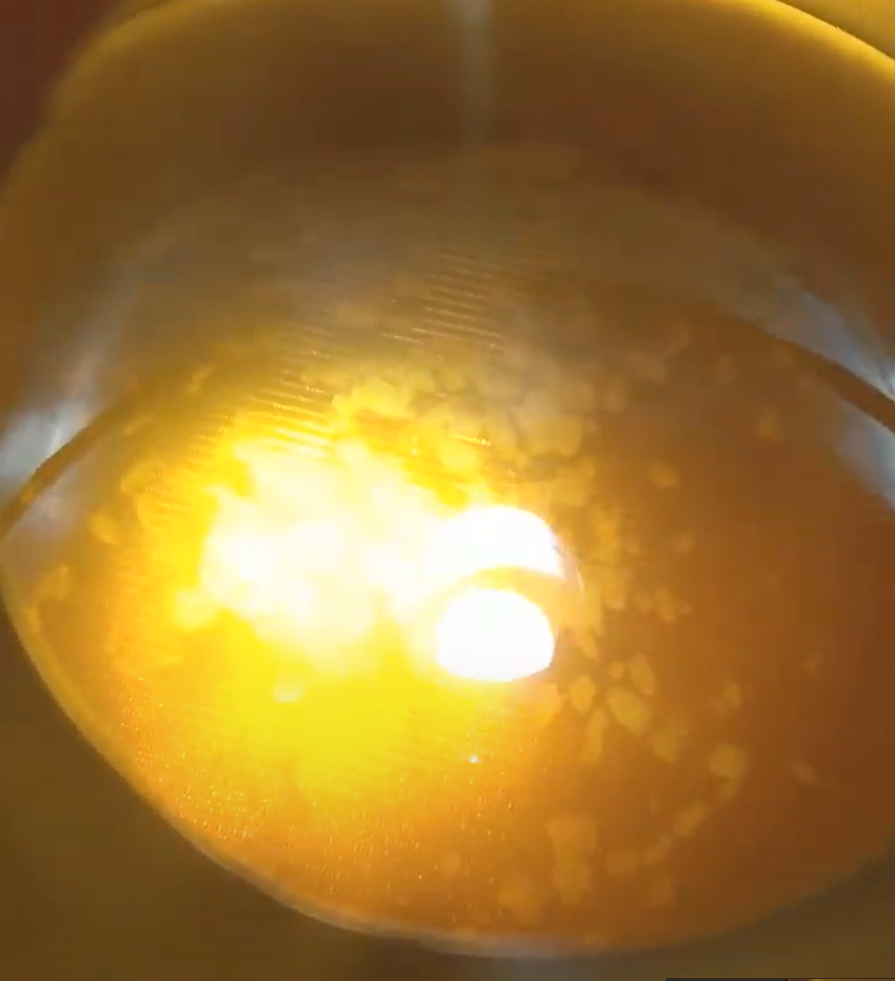
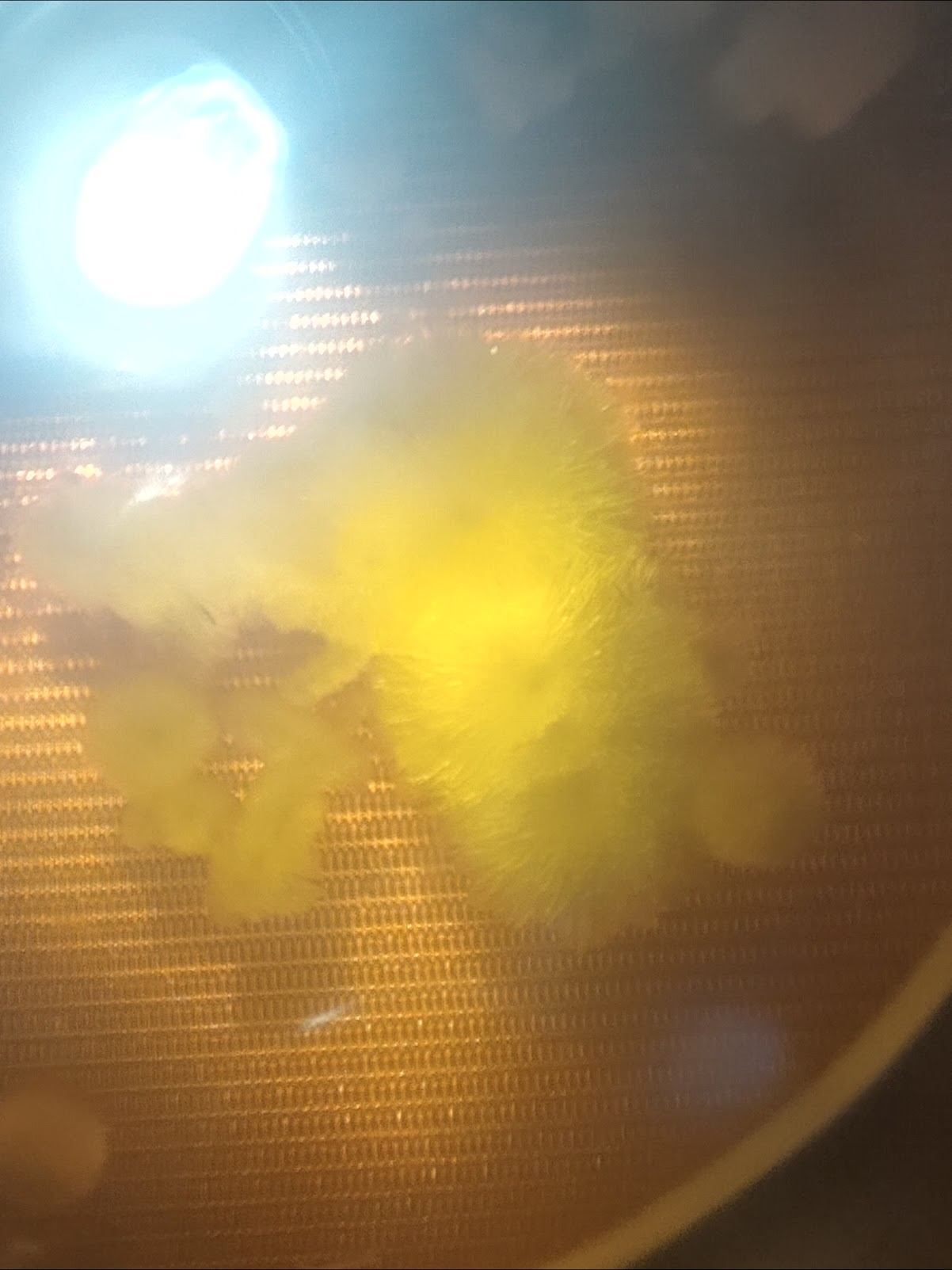
Isolation represents the final step of refinement forbotanical extractresulting in a highly refined concentrate of the target compound reaching upwards of 99% purity. WhileIsolation of target compounds can be achieved viafractional distillation or chromatography, the focus of this section will be oncrystallization as means ofIsolation.Crystallization is a purification technique used toisolate crystalline compounds from asolution. This is achieved by manipulating thesolubility of the target compound when dissolved in acrystallization solvent. This is most commonly achieved through theevaporation ofsolventor the cooling of thesolution to achievesupersaturation of the target compound within thesolution.
Crystallization utilizes the concept that different compounds have differentsolubilities within the samesolvent and that only molecules of the same crystalline compound will align into the lattice structure of the crystal formation; impurities can only stick to the outside of the crystal lattice or remain within thesolution. In practice,crystallization of a target compound is performed by achievingsupersaturation via either theevaporation of thesolvent from thesolution or cooling of asolution to reduce itssolubility to the point ofsupersaturation.
Supersaturation occurs when thesolute concentration of asolutionis pushed beyond thesolvent's solubility capacity at a given temperature. When asolution issupersaturated withsolute, it is pushed beyond its maximumsaturation capacity.Saturation is defined as the maximum amount of asolute that will dissolve in a given amount ofsolvent at a specific temperature. Asolution is consideredsaturated at a given temperature when no moresolutecan be dissolved within thesolution. Asolution can becomesupersaturated when thesolvent isevaporated, or thesolutionis cooled, reducing itssaturation capacity beyond the point ofsaturation. When asolutionbecomessupersaturated, it contains moresolute than thesolvent is capable of holding. This results in the clustering and alignment of a crystalline compound within thesolution, producing a crystalline structure precipitating out of thesolution. This process of precipitating a crystalline compound out of a solution is referred to ascrystallization.
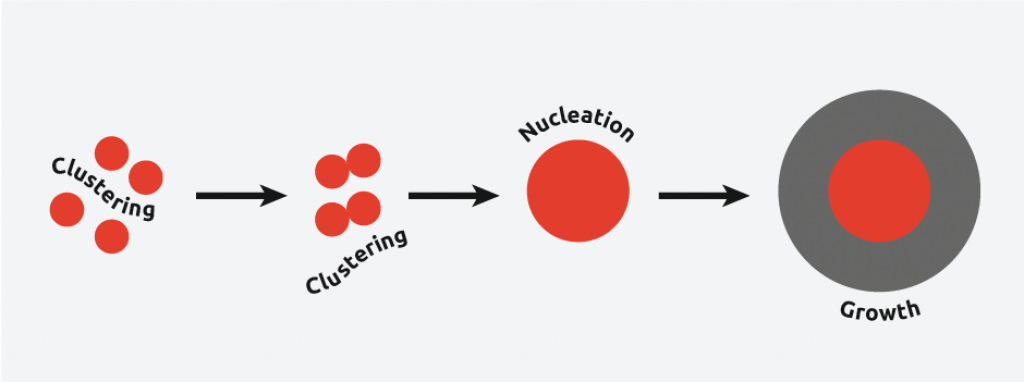
Crystallization is when solids form due to the alignment of molecules into a structure known as a crystal. The most common process ofcrystallization involves precipitating a crystalline structure from asolution.Crystallization within asolution occurs in three major steps:
Thesupersaturation of thesolution.
The spontaneous precipitation of a crystalline structure within thesolution referred to as nucleation.
The increase in the size of the initial crystalline structure referred to as crystal growth.
The attributes of the resulting crystal depend largely on factors ofsupersaturation such as temperature, and fluidevaporation. Typically, a slower temperature ramp or fluidevaporation forms a larger crystalline structure, triggering more crystal growth rather than nucleation If the size of the crystalline structure is of no concern, thecrystallization process can be accelerated by dropping the temperature of thesolution rapidly resulting in more nucleation sites and a preponderance of smaller crystalline structures.
Nucleation occurs within asolution when crystallinesolute molecules align and assemble within asupersaturated solution to form a crystalline structure. Thermodynamic and chemical properties drive both nucleation and crystal growth.Thesupersaturation level of thesolution drives the initiation of nucleation. During nucleation, molecules of the same compound cluster within asolution arranging themselves into a crystalline structure. Nucleation happens spontaneously over time when asolution issupersaturated, or initiated by cooling thesolution past the point ofsupersaturation.
For most chemical compounds dissolved in mostsolvents, directsolubility or thesolubility threshold of a compound increases and decreases within asolution as thesolution's temperature increases or decreases. This allows forsupersaturation to be achieved by reducing the temperature of thesolution. As thesolution is cooled, itssaturation capacity is lessened until thesolutionreaches the point ofsupersaturation. Whensupersaturation of asolutionis achieved, thesolution reaches a point where it can no longer keep the entirety of the target crystalline compound dissolved within thesolution resulting in precipitation of crystalline structure from the solution. This initial formation of a crystalline structure is referred to as nucleation.
Once nucleation of the initial crystalline structure is achieved, and crystal growth slows, further crystal growth can be attained through greatersupersaturation. Crystal growth is a dynamic process occurring in equilibrium with asolution's saturation capacity where the target crystalline molecules precipitate out of thesolution and dissolve back into thesolutionbased on thesolution's level ofsupersaturation. This process is insensitive to a change in temperature as long as thesaturation state remains unchanged.Supersaturation is the main driving force behind crystal growth. Once crystal growth has slowed,solvent evaporation orsolution cooling can be utilized tosupersaturate thesolution further and promote more crystal growth. Careful control of thesupersaturation level of thesolution is critical to ensure the desired crystal size distribution.
Once satisfied with crystal precipitation, the crystals can then be separated from thesolution viavacuum filteringor centrifugal separation resulting in a separation of the target crystalline compounds and the remainingsolution referred to as mother liquor. The mother liquorsolution often contains a small amount of the target crystalline compounds and other valuable botanical constituents found within the startingsolute. Mother liquor can be collected over time and further purified, or it can bepurged ofsolvent and utilized for its other constituents.
When the separation of the target crystalline compound and mother liquor has been achieved, the crystals can optionally be rinsed with a chilledcrystallization solvent like pentane orheptane to wash impurities from the surface of the crystal to increase crystal purity further.
At this point, the crystals are thenvacuumpurged at the boiling pointof thecrystallization solvent to remove residualsolventfrom the crystals before preparing a sample for third-party analysis to ensure their purity and absence of residualsolvent. Large crystals may need to be ground down to a fine powder topurge all residualsolvent from the crystalline compound.Crystallization is a dynamic process that can be accomplished in various ways using an assortment of differentsolvents. This section will focus on the two most common in botanical extractrefinement:evaporative crystallizationutilizingbutane and coolingcrystallization utilizingheptane.
General Crystallization Steps
Choose an appropriatecrystallization solvent. Common considerations include how muchsolute can be dissolved within a broad temperature range (solubility) and how practical thesolvent is to handle (safety)
Dissolve the product in thecrystallizationsolvent by increasing the temperature until thesolute completely dissolves into thesolution.
Reducesolubility via cooling orevaporation, achievingsupersaturation of thesolution to initiate crystal nucleation.
Once nucleation is achieved and crystal growth has slowed, initiate further crystal growth through greatersupersaturation viasolventevaporation orsolution cooling.
Once satisfied with crystal precipitation, drain andfilter the remainingsolution from the precipitated crystals and rinse impurities from the collected crystals with chilled pentane orheptane.
Vacuum purge and dry the purified crystals using avacuum oven set to theboiling pointof thecrystallization solvent.
Ensure the crystal's purity and status free of residualsolvent by preparing a sample for independent third-party analysis.
Chapter 6: Isolation Glossary
Biomass: Generic plant matter used in extraction. Composed of flowers, leaves, and other plant parts. Boiling Point: The boiling point of a substance is the temperature at which the vapor pressure of the liquid equals or exceeds the pressure surrounding the liquid causing the liquid to vaporize, observed as boiling. Botanical Extract: An extract created from botanical biomass material.
Buchner Funnel: Laboratory equipment used for filtration. Butane: An organic compound with four-carbon atoms classified as an alkane that is used for extraction.
Centrifuge: A device that uses centrifugal force to separate various compounds within a fluid. Closed Loop System: Extraction equipment that contains the solvent within a closed system without exposure to open-air.
Crystallization: The alignment or organization of atoms or molecules into a structure known as a crystal. Decarboxylation: A reaction that removes a carboxyl group. Distillate: The condensed vapor product of distillation.
Distillation: The action of purifying a liquid by a process of heating and cooling. Evaporation: The process of turning a liquid into a vapor. Extraction: The process of separating compounds via force or solvents. Extractor: The person, machine, or piece of equipment used for extraction.
Filter: To pass a liquid through a device to remove unwanted material. Fractional Distillation: Separation of a mixture into fractions differing in boiling points. Freezer: A refrigerated compartment, cabinet, or room used for the preservation of goods in a cooled atmosphere. Gas: An expanded substance or matter having no fixed shape or volume.
Glassware: A variety of scientific equipment made of glass.
GRAS: Generally Recognized as Safe a designation of a substance by the Food and Drug Administration. Heptane: A nonpolar alkane hydrocarbon consisting of seven carbon atoms. Hot Plate: A Flat heated surface used for conduction. Hydrocarbon: A compound consisting of hydrogen and Carbon. Insoluble: (of a substance) incapable of being dissolved.
Isolate: A person, group, or thing that has been isolated. Micron (pore size): A measurement used to describe the sizes of very small objects (μm Micrometer).
Nonpolar: A molecule without positive or negative poles. Phase Change: The physical process of transition between the basic states of matter.
Polar: having electrical or magnetic polarity. Polarity: The separation of an electric charge which leads the molecule to have a positive and negative end. Post-Processing: The process of further refining extracted resin or tinctures. Propane: A three-carbon alkane used for extraction. PTFE: A synthetic fluoropolymer used for adhesion of threaded pipes or joints. Purge: The act or instance of eliminating contamination from a substance. Reactor: A glass or metal device used to mix a solution in a contained atmosphere. Rotary Evaporator: A device used for the separation of solvents from samples via evaporation through the rotation of the boiling flask. Saturation: The degree or extent to which something is dissolved or absorbed compared with the maximum possible. Saturation Limit: The maximum amount of a substance that can be dissolved within a solvent. Selectivity (solvent): The preferential dissolving of one component of a liquid or solid from a mixture than of another.
Soluble: (of a substance) able to be dissolved. Solubility: The ability of a given substance, the solute, to dissolve in a solvent. Solute: The minor component in a solution, dissolved in the solvent. Solution: A mixture in which the minor component is uniformly distributed into the major component to form a homogeneous mixture. Solvent: A material able to dissolve other substances. Solvent Recovery: The process of extracting useful materials from waste or by-product solvents generated during manufacturing. SOP (Standard Operating Procedure): A documented process set in place to ensure services or products are delivered consistently.
Supersaturation: Containing an amount of a substance greater than that required for saturation. Tri-Clamp: A quick-release mechanical joint for pipes, valves, or fittings in sanitary installations.
Vacuum: A space devoid of matter Vacuum Oven: A heated low-pressure environment used for delicate drying processes. Vapor: A substance in the gas phase. Vapor Pressure: The pressure exerted by a vapor in thermodynamic equilibrium with its condensed phase at a given temperature in a closed system. Viscosity: The thickness of a fluid. Winterization: The process of removing the lipids from a botanical extract by cooling and filtering.
EVAPORATIVE CRYSTALLIZATION
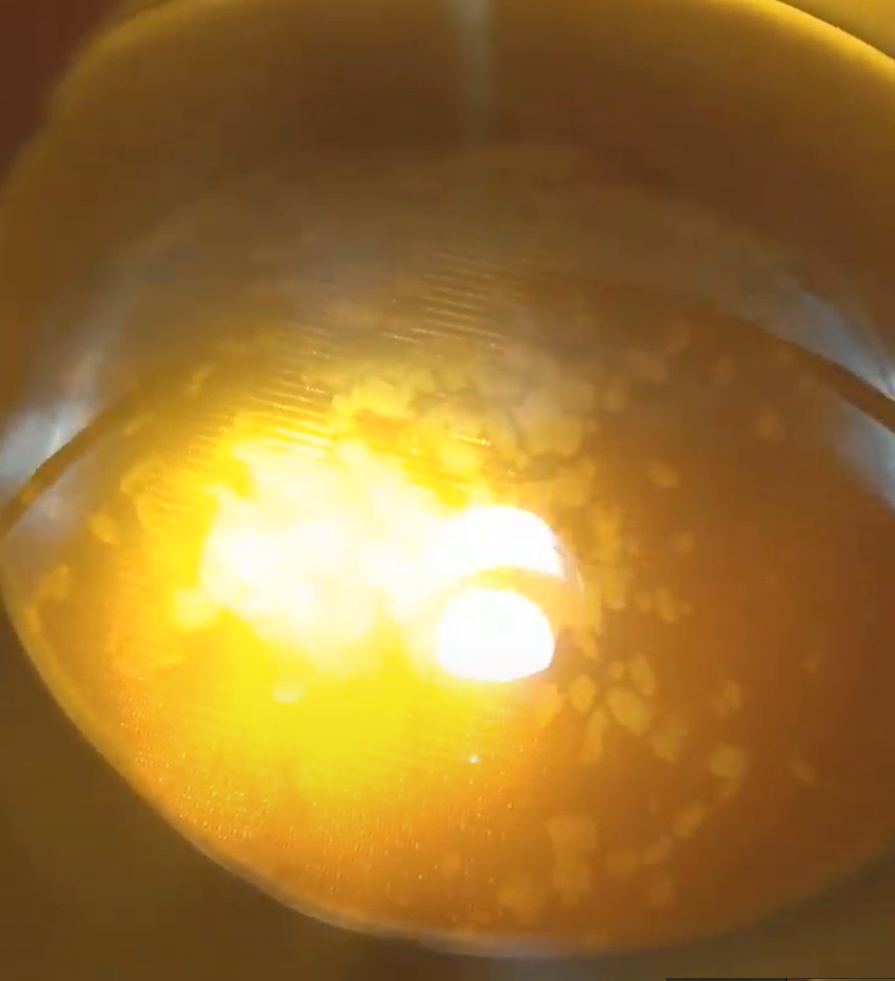
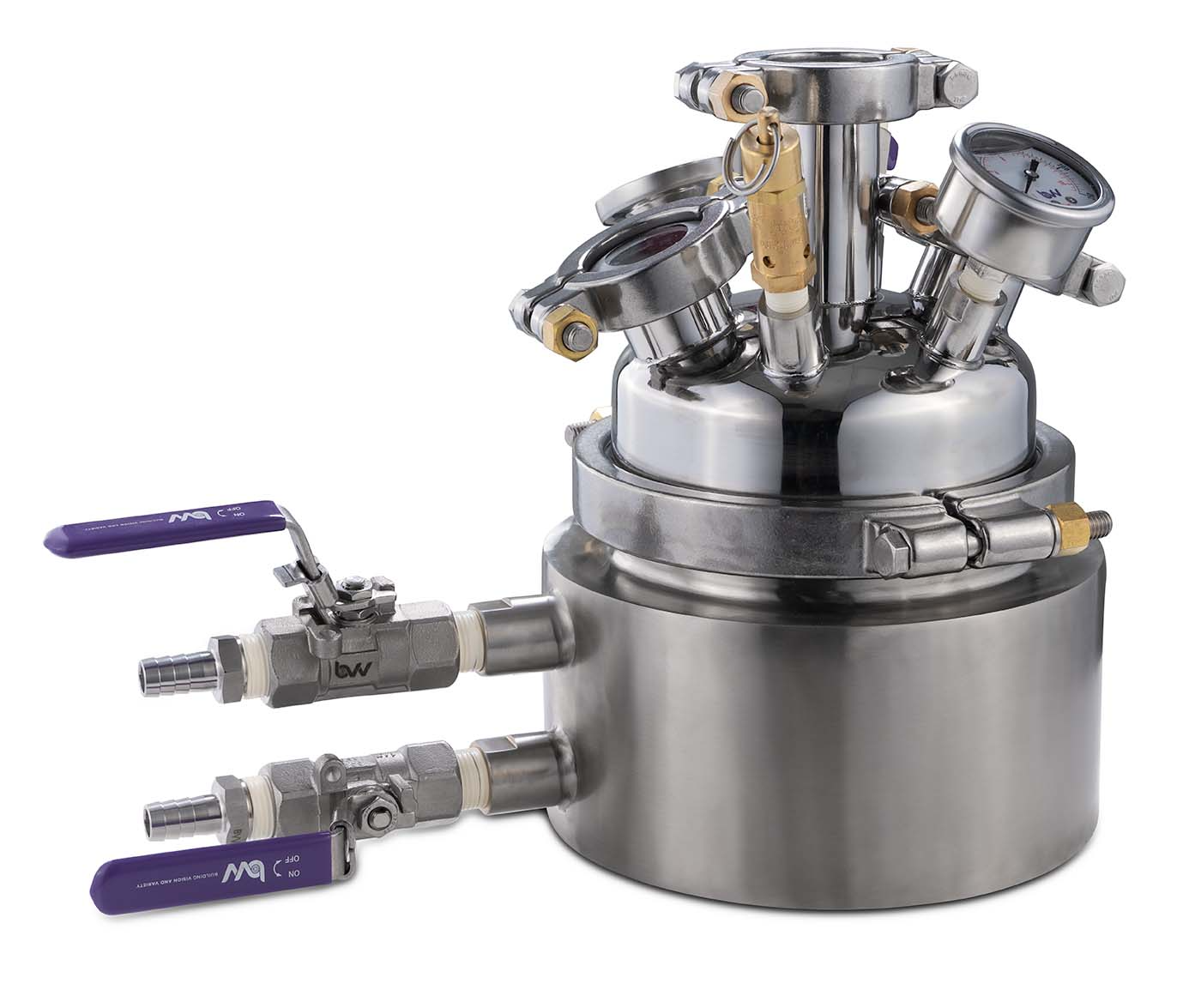
Jacketed Diamond Miner By BVV
Evaporative crystallization utilizes theevaporation of thecrystallization solvent in order tosupersaturate asolution and achievecrystallization of a target crystalline compound.Supersaturation occurs when thesolute concentration is pushed beyond thesolvent's solubility capacity at a given temperature. When asolution issupersaturated, it holds more dissolvedsolute than its maximumsaturation capacity, which triggers the precipitation of a crystalline structure out of thesolution.Saturation is defined as the maximum amount of asolute that will dissolve in a given amount ofsolvent at a specific temperature. Asolution is consideredsaturated at a given temperature when no moresolute can be dissolved within thesolution.
Evaporative crystallization achievessupersaturation of asolution by theevaporation ofsolvent from thesolution reducing thesolution's overall amount ofsolvent.Supersaturation is achieved when enoughsolvent within asolution isevaporated, thus pushing thesolution beyond itssaturation capacity. Uponsupersaturation, asolution contains more dissolvedsolute thansolventis capable of holding. This results in the clustering and alignment of a crystalline compound within thesolution producing a crystalline structure precipitating out of thesolution.
For teaching purposes, let us say 5lbs ofbutanecan dissolve a maximum of 1lb of a target crystalline compound at 24C/75F inside a closed system. This would be its maximumsaturation capacity; it is incapable of dissolving any more of that compound. If we were toevaporate off 1lbs of thebutane, the remainingsolution would becomesupersaturated, meaning that thesolution contains more dissolvedsolute than it is capable of maintaining dissolved. Oncesupersaturation of thesolution is achieved, it triggers the clustering and alignment of a crystalline compound within thesolution, resulting in a crystalline structure precipitating out of thesolution.
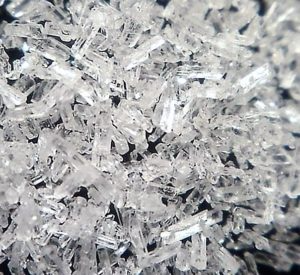
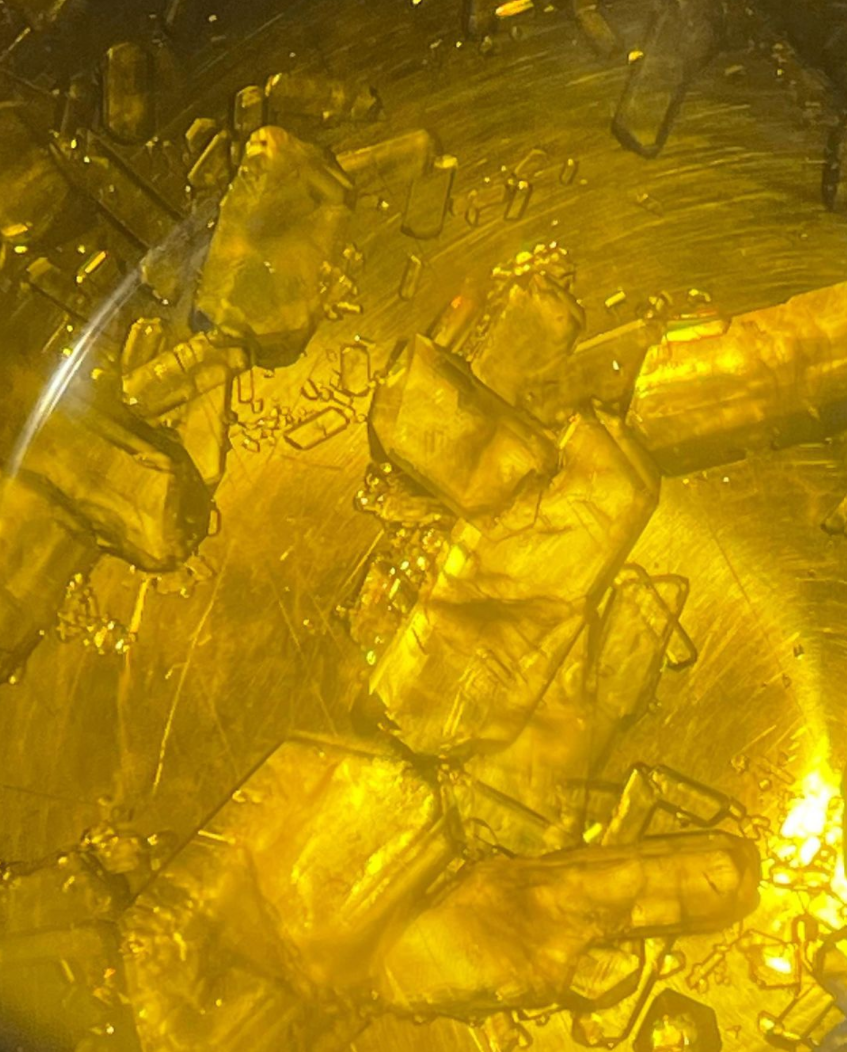
Crystals By Chemtek
This process of precipitating a crystalline compound out of asolution is referred to ascrystallization.Crystallization is the process by which a solid forms, due to the alignment of molecules into a structure known as a crystal. Duringevaporative crystallization, this process occurs in three major steps:
Thesupersaturation of thesolution
The spontaneous precipitation of a crystalline structure within thesolutionreferred to as nucleation
The increase in the size of the initial crystalline structure referred to as crystal growth achieved via furthersupersaturation
The attributes of the resulting crystal depend largely on factors ofsupersaturationachieved via fluidevaporation. Typically, slower fluidevaporation forms a larger crystalline structure, triggering more crystal growth than nucleation. Thesupersaturation level of thesolution drives the initiation of nucleation. As asolution becomes moresupersaturated, molecules of the same crystalline compound cluster within asolution arranging themselves into a crystalline structure. Nucleation happens spontaneously over time when asolution issupersaturated. This process can take days or weeks, depending on the starting purity of thesolution and its level ofsaturation.
Prior to nucleation, thesolvent should be slowlyevaporated from thesolution until nucleation spontaneously occurs. Once nucleation of the initial crystalline structure is achieved, and crystal growth slows, further crystal growth can be attained through greatersupersaturation. Crystal growth is a dynamic process occurring in equilibrium with asolution's saturation capacity. The target crystalline molecules precipitate out of thesolution and dissolve back into thesolution based on thesolution's level ofsupersaturation. Supersaturation is the main driving force behind crystal growth. Once crystal growth has slowed,solvent evaporation can be utilized tosupersaturate thesolution further and promote more crystal growth. Careful control of thesupersaturation level of thesolution is critical to ensure the desired crystal size distribution.
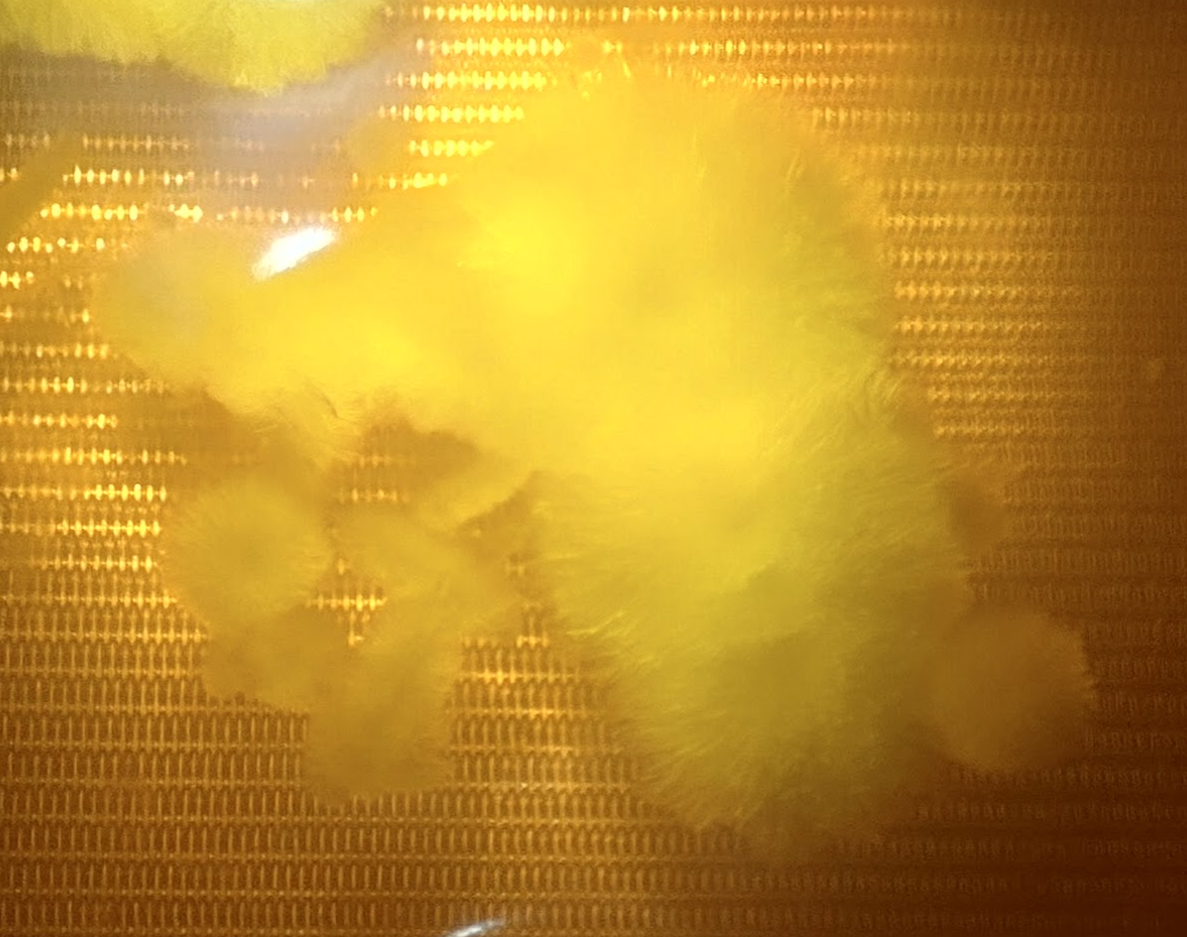
EvaporativeCrystallization By Oleum Extracts
The process of nucleation can be skipped through the introduction of a seed crystal of the target compound, acting as a starting point for crystal growth to occur. Regardless of seeding once a crystal has been nucleated. Crystal growth is accelerated by furtherevaporating solvent from thesolution slowly or incrementally. Commonly this process is performed by a quick off-gassing of the vessel tosupersaturatethesolution further. This is typically performed once crystal growth has halted to re-accelerate crystal growth. As the crystals grow, light agitation can also be utilized to negate the clumping of crystals.
Evaporative crystallization is most commonly performed with a highly volatilesolvent likebutane andpropane. These lighthydrocarbons' lowboiling points are ideal forevaporative crystallization because thesolvent can beevaporated from thesolutioneasily to increasesupersaturation without overheating thesolution and redissolving the crystals. This section will utilizebutaneas both ourcrystallization solvent and ourextraction solvent withevaporative crystallization in mind. When planning to performevaporative crystallization after an initialbutane extraction the initialextraction of the target crystalline compound should be performed to limit the pickup of impurities and maximize the concentration of the target crystalline compound. This is most commonly achieved by chilling thebutane prior toextraction and refining the resultingsolution through inline adsorbent filtration.
Typically, the greater thesolution’s starting purity, the greater theisolation yield. Once the refinedextraction solution has made its way to the collection vessel, thesolvent recovery process will be initiated, recovering the bulk of thesolvent, leaving enoughbutane remaining in thesolution to achievesupersaturation.Evaporating the majority of thesolvent from thesolution increases thesolute concentration past itssolubility threshold, achievingsupersaturation. Once nearsupersaturationis achieved, typically gauged by a slight increase ofviscosity of thesolution, thesupersaturated solution is then transferred to apressure vessel, and the slowevaporation ofsolvent furthersupersaturates thesolution until nucleation is achieved. After the initial nucleation is achieved, small amounts ofsolvent can beevaporated from thesolution once crystal growth slows, increasingsupersaturation and re-initiating crystal growth.
Once satisfied with crystal precipitation, the remaining mother liquorsolution can be separated viavacuum filtration or centrifugal separation beforevacuum purging both products separately. Once both products have been sufficientlypurged, a sample of both should be sent out for third-party analysis to confirm potency and status free of residualsolvents.
EVAPORATIVE CRYSTALLIZATION STANDARD OPERATING PROCEDURE
Purpose
The purpose of this procedure is to provide detailed instructions forbutane crystallization from an initialbutaneextraction.
Scope
This procedure applies to all lab technicians tasked withevaporative crystallization of abotanical extract.
Definitions/Acronyms
Personal Protection Equipment (PPE)Items worn to protect employees from exposure to hazardous materials and prevention of injury.
Safety Data Sheet (SDS)Provides useful information on chemicals, describing the hazards the chemical presents, and giving information on handling, storage, and emergency measures in case of an accident.
PPE: The following should be worn by all lab personnel while extracting and performing thiscrystallization procedure :
Protective eyewear
Lab coat
Gloves
5. Hazard Identification
Preparation and Use: Target compounds will be extracted frombiomass material withbutane as thesolvent. The recovery of thesolvent from thesolution will be done in a controlled manner to achievesupersaturation. Thesupersaturated solution will be stored under pressure for a period of time allowing forcrystallization to occur.
Frequency- An initial volume ofsolvent is used, no more is added.
Location-Extraction occurs within aC1D1 environment, inside of aclosed-loop hydrocarbonextractor(BVV).Crystallization occurs in a secondary pressure-rated vessel (BVV) inside an appropriately rated C1D1 explosion-proof environment.
Potential Hazards and Risks
SeeButane SDS for detailed risks.
6. Preparation
1. Load the material column with freshbiomass packing the material tightly and evenly.
2. Assemble the closed-loopextractor and pressure test the system at 100 PSI for at least an hour to ensure the system is assembled correctly with no leaks. If pressure drops, proceed to identify the leak with soapy water and disassemble and reassemble as necessary. If pressure is held, depressurize the system and proceed to the next step.
3. Attach aspark-freevacuum pumpto the collection base of the closed-loop system and open all process flow valves from the collection vessel to the sourcesolvent tank. This will ensure thesolvent tank valve is fully closed before pulling the entire system undervacuum. Once the system has reached -30mmHg, close all processing flow valves on the systemisolating each vessel, and turn off the spark-freevacuum pump.
3. Proceed to chill theextraction solventto (-30C or colder) through the use of dry ice or an appropriately sized chiller.
5. Once theextractionsolventhas been sufficiently chilled, remove thesolvent tank from the chilling bath, place it onto arefrigerant scaleand record the starting weight.
7. Procedure
1. If possible, pressurize thesolvent tank with nitrogen to 20 PSI. Open the liquid injection valve on the material column and pass thesolventthrough the material column at a 5:1 ratio (solvent: material).
2. After initialsaturation of the material column, slowly open all processing flow valves from the material column, through thecolor remediation column, to the collection vessel and send thesolution through an inline color remediation column directly into the collection vessel. Add additional nitrogen back pressure as necessary to collect the entirety of the extractsolution.
3. Once the entirety of thesolutionhas entered the collection vessel, close the collection vessel input valve and open recovery line valves from the collection base to the LP tank.
4. Turn on theheated recirculator, set the temperature to 50C/122F, and open all the recirculation valves to apply heat to the collection vessel.
5. Recover the majority of the startingsolvent untilsupersaturation of thesolution is achieved, indicated by a slight increase inviscosity, ensuringbutane remains in thesolution before closing recovery line valves.
6. Connect a pressure-ratedcrystallization vesselto the output of the collection base and send thesupersaturated solutionto the pressure-ratedcrystallization vessel.
7. Offgas the vessel in a C1D1 rated extraction booth for 1-2 hours until the solution stabilizes before sealing the vessel.
8. Ensure the vessel is completely sealed and store it for 1-2 weeks at 27-30C/80-86F, If crystallization doesn't occur off-gas the vessel tosupersaturate thesolution further and wait until crystals spontaneously nucleate.
9. Once nucleation has been achieved and crystal growth has diminished off-gas the vessel incrementallyevaporates off small amounts ofsolvent to increasesupersaturation and reinitiate crystal growth.
10. As the crystals grow, lightly agitate thesolution to reduce crystal clumping as necessary.
11. Once desired crystal growth has been achieved, pour off the mother liquor into a pyrex dish andvacuum purge the extracts separately at 80-100F under fullvacuumfor 24-72 hours as necessary until no residualsolvent remains.
12. Store crystals in a cool dark place to limit degradation.
13. Send out a sample for lab testing to confirm purity and ensure all residualsolvent has been removed.
COOLING CRYSTALLIZATION
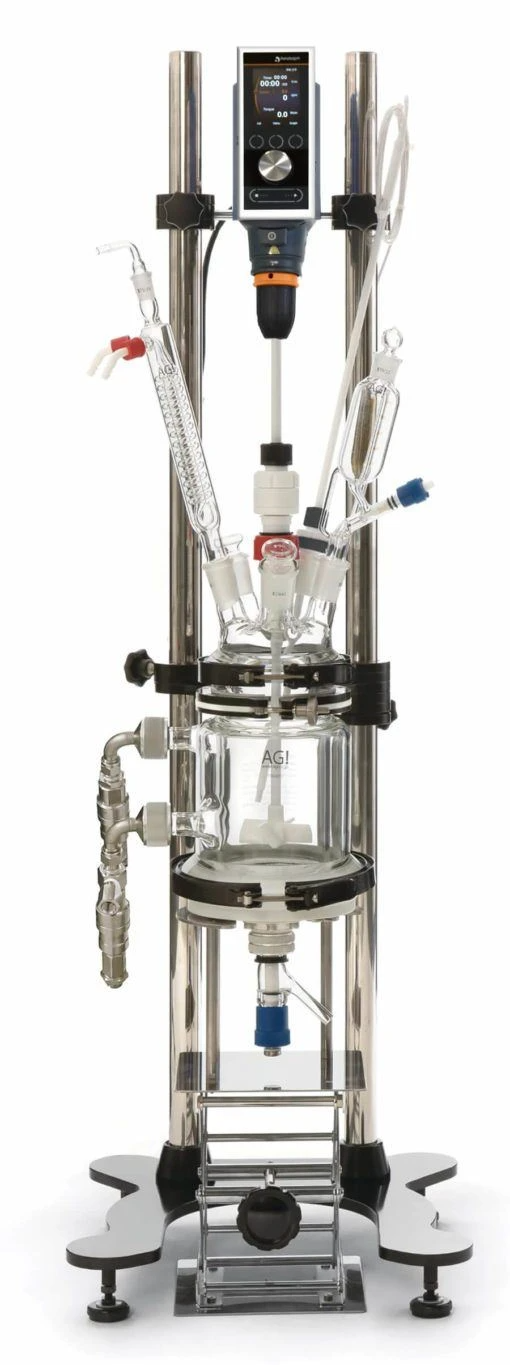
5L Asahi Glass BenchtopFilter Reactor System By Cascade Sciences
Coolingcrystallization is a purification technique utilized across many industries toisolate target crystalline compounds. Inbotanical extractrefinement, this is typically performed by dissolving a highly refineddistillate above 80% purity of the target crystalline compound into acrystallization solvent by applying heat and cooling thesolution to achievesupersaturation of thesolution resulting in the precipitation of the target crystalline compound.
In order to perform an efficient coolingcrystallization, the startingsolution must be relatively pure, with the higher the starting purity, the better. Typically a highly refineddistillatewith greater than 80% purity of the target crystalline compound will be used as input to perform a coolingcrystallization. The process of coolingcrystallizationstarts by first dissolving the high purity concentrate of the desired crystalline compound into thecrystallization solvent through the application of heat and incrementally cooling thesolution to achievesupersaturation resulting in the target compound precipitating out of thesolution.
Cooling crystallization is typically performed utilizing a jacketed vessel with stirring capability where the crystallization is performed. A high-powered refrigerated heated circulator controls the temperature of the vessel to dissolve the solute into the crystallization solvent and trigger the crystallization process via cooling. A vacuumfiltration apparatus is used to separate the resulting crystals from the mother liquor solution. A vacuum ovenis utilized to purge the resulting crystals and mother liquor solution of residual crystallizationsolvent.
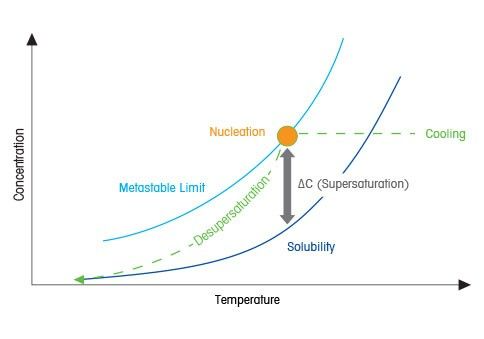
Solubility Curve By Mettler Toledo
In order to perform a coolingcrystallization, the target crystalline compound we are looking toisolate needs to be dissolved into asolvent that the target compound issoluble in when heated but isinsoluble in the samesolventat chilled temperatures. The moreinsoluble at lower temperatures, the better, as this improves the theoretical yields over a practical temperature change by driving more of the target crystalline compound out ofsolution.
The ideal coolingcrystallization solvent allows for the target compound to be fully dissolved within thesolvent, forming asolution through the application of heat while triggering the precipitation of the same compound by reducing itssolubility via cooling. Thehydrocarbon solvents pentane andheptane are commonly utilized to perform coolingcrystallization ofnonpolarcrystalline botanical compounds.
In most cases, thesesolvents are effective because they allow for thesolubility of a compound to be increased through heat and decreased through cooling. Thissolubility difference between temperature ranges is the basis of coolingcrystallization. This allows a crystalline compound to be dissolved with heat and precipitated from thesolution when cooled.
Nucleation Occurring
As thesolutionis cooled, itssolubility is reduced until it becomessupersaturated. It reaches the point where thesolution can no longer maintain the target crystalline compound dissolved within thesolution. This process initiates the clustering and alignment of a crystalline compound within thesolutionresulting in a crystalline structure referred to as nucleation.
During a coolingcrystallization, the resulting crystal size and structure are governed by the relative rates of nucleation and crystal growth. These, in turn, are driven thermodynamically by the level ofsupersaturation. Nucleation tends to dominate at highsupersaturation levels, giving rise to a preponderance of smaller crystals. At lowsupersaturation levels, crystal growth tends to dominate, resulting in fewer but larger crystals. Typically a coolingcrystallization will be initiated by cooling at a constant predetermined rate over a predetermined temperature range. While this is quite straightforward from a process control perspective, it often means thatsupersaturationlevels and the relative rates of nucleation and growth can vary during cooling.
Crystal Growth Occurring
After the cooling process is complete and the desired crystal precipitation is achieved, the crystalsolution is thenvacuum filtered to separate the remaining mother liquorsolution from the crystals. Once separation of the crystals and mother liquorsolution is achieved, the freshly harvested crystals are then rinsed with chilledcrystallization solvent. This will remove impurities outside the crystals beforevacuum purging the crystals under fullvacuum at or near theboiling pointof thecrystallization solvent to remove any traces of residualsolvent.
After thevacuum purging process is complete, a sample of the crystals can be prepared for independent third-party testing to ensure the crystals are of the highest purity and free of residualsolvent. If the desired potency is not obtained, the crystals can be redissolved incrystallization solvent and recrystallized to achieve anisolate of the highest purity.
The remaining mother liquorsolution often contains a small amount of the target crystalline compounds and other valuable botanical constituents found within the startingsolute. Mother liquor can be collected over time and further purified, or it can bepurged ofsolventand utilized for its other constituents.
COOLING CRYSTALLIZATION STANDARD OPERATING PROCEDURE
Purpose
The purpose of this procedure is to provide detailed instructions for coolingcrystallization utilizingheptane as thecrystallization solvent.
Scope
This procedure applies to all lab technicians tasked with cooling crystalization.
Definitions/Acronyms
Personal Protection Equipment (PPE)Items worn to protect employees from exposure to hazardous materials and prevention of injury.
Safety Data Sheet (SDS)Provides useful information on chemicals, describing the hazards the chemical presents, and giving information on handling, storage, and emergency measures in case of an accident.
Mother LiquorThe liquid mixture remaining after crystal filtration.
Distilled OilIn this application distilled oil will mean winterized, decarboxylated, and distilledbotanical extractcontaining 80% or more of the target crystalline compound by weight.
1. Heatdistillate to 120F/48.88C using a convection oven until thedistillate is vicious enough to be poured and transferred to thecrystallization reactor.
2. Ensure there is adequate chilledheptane in a C1D2freezer available for washing thereactor near the end of the process (1-5 Liters)
3. Ensure thecrystallization reactor and all auxiliary support equipment are clean, operational, and grounded.
6. Procedure
Crystallization
Once thedistillatehas reached the appropriate temperature, slowly transfer thedistillate into thecrystallization reactor.
Bond the n-heptane container to the reactor and transfer the n-heptane in a 3:1 ratio ofheptane to the total amount of weight ofdistillate added, ensuring thecrystallization reactordoes not exceed 50% of its maximum volume.
Once thedistillateandheptane have been loaded into thereactor, seal the system by closing all valves or ports.
If applicable, turn on thereactormotor and slowly ramp the speed, setting to 50% of its total speed.
Set the jacket temperature to 60C/140F.
Once the jacket has reached 60C/140F, note the start time and wait 15 minutes to ensure thesolution is completely homogenous.
Once thesolution appears to be completely homogenous, set the circulator temperature to 5c with a ramp of 0.5 degrees Celsius per minute.
When the temperature of the mixture has reached 5C/41F, it is to be held at 5C/41F for 1 hour until full nucleation has occurred.
Once satisfied with nucleation, increase stir speed to 80% and set the chiller to -20C/-4F with a ramp of 0.5 degrees Celcius per minute.
Once thereactor has reached -20C/-4F, maintain this temperature for 1 hour and then stop the stirrer and raise it above the crystals if possible.
Set the circulator temperature back to 5C/41F.
Attach avacuum line to the outlet of thereactor to a receiving vessel connected to avacuum pump.
Turn on thevacuumpump attached to thefilter bottle and open thereactordrain port to separate the mother liquor from the crystals.
Once all the filtrate has been removed, close thereactor outlet valve and wash the crystals withHeptane chilled to -40C/-40F. Wash crystals until desired purity is achieved.
Dry for 30 minutes undervacuum ensuring yellowing of the material does not occur.
Once the drying time has elapsed, turn off thevacuumand the circulator and remove the crystals slowly from thereactor.
Recover theheptane from the mother liquor in a rotary evaporatorat 90C/194F.
Crystal Processing
Carefully transfer theisolate to a clean processing room.
Weigh and record the totalisolate weight.
Prepare clean drying pans using clean gloves and tools. Place theisolate onto a parchment paper or a chemical resistantPTFE sheet, and distribute theisolate powder evenly ontovacuum oven trays with under half an inch of thickness per tray.
Ensure the ovens are clean and thevacuum system and cold trap are set up properly on the system.
Place thevacuumoventrays into thevacuumoven carefully and close thevacuum oven door sealing the system.
Set thevacuumovento 60C/140F and pull the system under fullvacuum, allowing theisolate to sit in thevacuumovensfor at least 12 hours.
Take a sample from the material and send it off for third-party analysis to confirm its potency and status free of residualsolvent.