
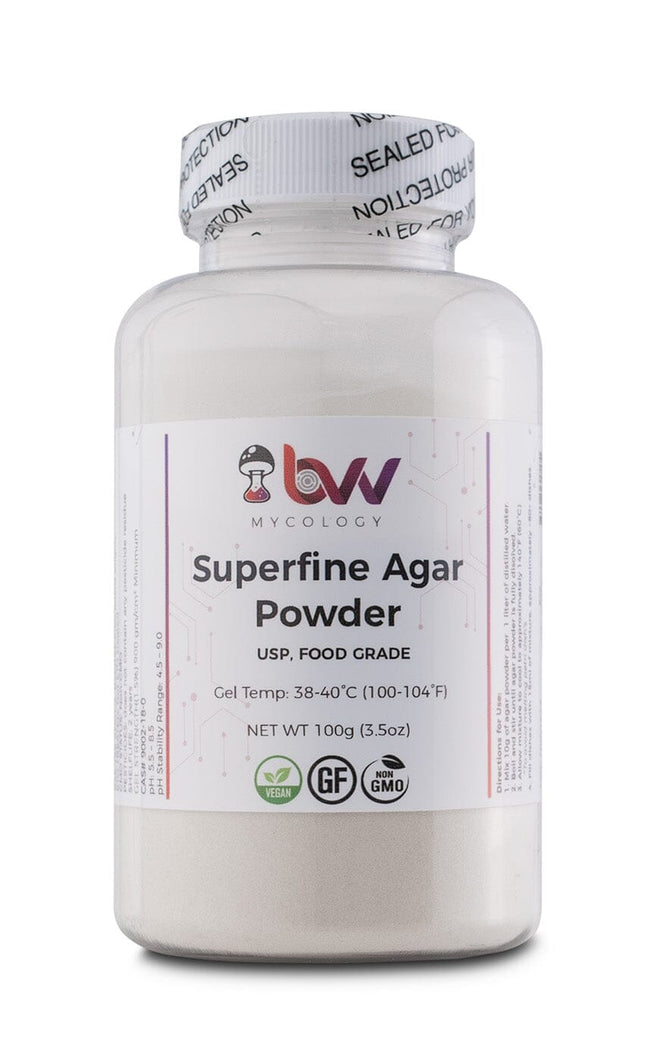

The Agar collection at BVV features premium-grade seaweed-derived polysaccharides, refined for maximum clarity and gel strength. As the essential medium for microbiology and mycology, our Bacteriological Grade Agar provides a consistent, nutrient-neutral foundation for culturing fungi, bacteria, and plant tissues.
Beyond the laboratory, we offer high-purity Food Grade Agar, a versatile vegan alternative to gelatin used as a thickener and stabilizer in various culinary and botanical formulations. Whether you are performing high-precision petri dish work or industrial food processing, BVV offers scalable inventory from individual jars to bulk quantities. Centrally located in Illinois, we provide rapid, reliable shipping to ensure your lab or production line remains operational.
What is the difference between Bacteriological and Food Grade Agar?
Bacteriological Grade Agar is highly refined to remove impurities that could interfere with microbial growth or clarity, making it ideal for petri dish culture work. Food Grade Agar is refined for culinary use as a stabilizer and thickener but may contain trace nutrients that make it less precise for sensitive laboratory cultures.
What is the standard gel strength of your Agar?
Our Agar typically features a high gel strength (often 700–1000 g/cm²), which ensures that petri dishes remain firm and stable during inoculation and incubation at various temperatures.
Can I use this Agar for Mushroom Mycology?
Absolutely. Agar is the gold standard for mycology. It allows growers to isolate specific strains, clean up contaminated cultures, and expand mycelium on a flat surface before moving to grain or liquid culture.
How do I prepare Agar for Petri Dishes?
The standard ratio is approximately 15-20 grams of Agar per liter of water, often supplemented with nutrients like Light Malt Extract (LME) or Dextrose. The mixture must be sterilized in an autoclave or pressure cooker at 15 PSI for 15-20 minutes before pouring.
Is Agar vegan-friendly?
Yes. Agar is a 100% plant-based polysaccharide derived from red algae (seaweed), making it the premier vegan alternative to animal-based gelatin for food and laboratory applications.
What is the melting and gelling temperature of Agar?
Agar is unique because it exhibits "hysteresis." It typically melts at approximately 85°C (185°F) but does not turn back into a solid gel until it cools down to about 32–40°C (90–104°F).
Do you offer bulk wholesale pricing for Agar?
Yes. We support large-scale mycology farms and industrial food processors with bulk quantities and tiered pricing. Contact our sales team for custom quotes on high-volume orders.
How should Agar powder be stored?
Store in a cool, dry place in an airtight container. If kept away from moisture and direct sunlight, Agar has an extremely long shelf life of several years without losing its gelling properties.
Is a signature required for Agar delivery?
No. Agar is a non-hazardous, non-toxic organic material. It can be shipped via standard ground carriers without the added costs or signature requirements of Hazmat chemicals.
Why buy Agar from BVV in Illinois?
Based in the Chicago suburbs, we offer rapid 1-3 day shipping to the East Coast and Midwest. Our central location allows mycologists and labs to restock their media quickly without the long lead times of West Coast suppliers.